Saturday, August 02, 2014

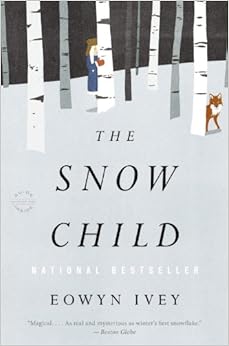
The Snow Child by Eowyn Ivey


The prodigal daughter is back to the book blog! I know, I know. I've been gone the longest time.  Truth be told, I just wasn't reading fiction. I don't know what got into me, but my brain just said "no" every time I tried to delve into a new story. But I was at the library last week to pick up some picture books for my class when my eye was drawn to the cover of The Snow Child, propped up in a hopeful manner on the Staff Recommends book display.

I stopped.

I read the back cover.

I snatched it into my bag like the treasure it turned out to be.

It took me about three or four days to read this quiet story. The quiet comes from all the snow (it's set in the Alaskan frontier wilderness of the 1920's) and the gentle way Ivey's story gently draws you in. Jack and Mabel are an older childless couple who have moved to Alaska to rely upon the company of each other and escape the judging glances of polite society. But a melancholy and regret tugs at both of their hearts for the child they lost so long ago.

One night, in an uncharacteristic playful romp in the season's first snow, they fashion a beautiful snow child with bright red gloves and cap. The next morning she's gone but footprints lead away towards the forest, forcing reader and characters alike to ask difficult questions about what is real and what is fantasy, where wild begins and humanity ends. So many times while reading this book I stopped to pause and gaze off, turning a contradiction around in my mind, trying to puzzle it through. I confess I found no solid answers which is why I want someone else to read this book so I have someone to talk to about it. But be warned...it's a book that will get me talking fast and confused and happy....prepare thyself.

I only found out after reading this debut novel that it was nominated for a 2013 Pulitzer. It didn't win, which means The Orphan Master's Son must be a real gem - The Snow Child was near-perfect in my book.

Please, when someone reads this, let me know. I can't wait to discuss.

And I'm glad to be back.

Ahem. 

Sunday, July 27, 2014

Jonathan Strange & Mr. Norrell by Susanna Clarke

This may take a little longer than usual, possibly because the book is longer than most we've reviewed (846 pages) and because it is very good with flaws.

The concept is that magic was widely practiced in the British Isles in ancient times but had fallen into a mere academic study by the early 19th century.  Mr. Norrell, a recluse living in rural England, decides to reinvigorate English magic, but really wants to be the only English magician, thwarting all others from engaging in the practice.  He is successful in actually producing some pretty good magical outcomes, but is so hesitant to take on wide spread practical magic that it quickly becomes frustrating to both the characters in the book and to the reader.  A second man, Jonathan Strange, comes on the scene who seems to have a greater gift for magic but must use different means to learn the craft since Norrell has horded all the books.  Norrell uses the help of a Fairy to solve a difficult problem which introduces a great deal of difficulty to those who received the help, as well as those around them.  There you have well over the first 200 pages.

The book is suffused with the manners and mores of the gentry and nobility of that time and there's subtle satire throughout the book to that effect.  However, do not think this is Pride & Prejudice meets Harry Potter.  It is written in the style of P&P, with a leisurely telling of different social situations interspersed with real action.  There were those who wanted to start their own version of Hogwarts, but Norrel wouldn't let them.

When researching what others said about this book, there were many reviews ranging from 5 to 1 star, most in the upper range, and all the points were accurate.  Each chapter is well written and can stand alone but the arc of the plot is choppy and is less compelling until the middle.  From there, the book becomes more compelling because there are enough people to care about who need help, and there is enough magic to possibly resolve the issues, that the somewhat disjointed plot can be overlooked.  I found myself reading larger and larger portions of the book at each sitting.  The story does not conclude as much as it just ends, but at a satisfy point.  You sense that the characters will go on, but to what end is anyone's guess.

The sense of the disjointed, almost insane world that belongs to the Fairy kingdoms can be compared to those described in "The Book of Lost Things" by John Connolly.  Although I could not find it in scanning Connolly's book, I'm sure one of the stories within JS&N also appears there.  Since both authors are from the British Isles, perhaps it is a story known in British folk lore.  If you like "The Book of Lost Things" you probably will like this.  Ms. Clarke's story is highly inventive and clever and she is an excellent writer.  I'm not sure editing the story down a hundred pages or so would be right for this book, unlike each of the Potter books, but I had started this book years ago and put it down somewhere around the 200 page mark.  I'm glad I went past that point this time.  Of the family, only Amanda would be interested in this.

Thursday, July 17, 2014

Spies Of The Balkans by Alan Furst

Alan Furst is one of the best writers for portraying spies working just before and at the beginning of WWII.  You could not go wrong in picking up any of his novels and this 2010 addition is a great story well told.  In a Greek port city, a policeman is selected to handle special cases that need great care.  He is good at his job but he and the rest of Greece watch uneasily as Hitler starts taking over its neighbors country by country. Meanwhile, Italy is looking for somewhere to go to show they have the right stuff to be another country to be feared in Europe.  It is only a mater of time before Italy tries to invade and Costa Zannis, our subtle detective, gets drawn into all the complications associated with helping refugees out of Germany, preparing for the hesitance, and weeding out German spies.

Whenever you read an Alan Furst novel, you get the feeling that these are real people, not superheros, who are dealing with difficult situations as best they can and that the story easily could have happened like this.  In this instance, the story moves right along, builds good suspense without dragging out the situation and has a satisfying ending.  It's a great summer read.

Tuesday, June 24, 2014

The Unlikely Pilgrimage of Harold Fry by Rachel Joyce

A journey of discovery can make for a very satisfying read, with the journey itself normally being more important than the end goal.  I think a boy traveling down a big river with a runaway slave on a raft was my first encounter with the genre; this version is almost the other side of the coin.

Harold is retired, repressed, and for all practical matters alone, even though he still lives with his wife.  He has lived a mostly unremarkable, unnoticed existence when a letter comes from a friend from work who has been gone for twenty years telling him that the friend has cancer.  After writing the lamest of short letters in response, he starts to mail the letter but keeps going to the next mail box, and then the next, ruing his inability to give a better response to one of the few people he could ever think of as a friend.  With the clothes he is wearing when he left the house, including a pair of boat shoes, he decides he can prolong his friend's life by walking the length of England to see her.

The results are a story of discovery about himself, his marriage, his family, people in general and the possibility of redemption.  It is sad to see someone live most of their life in fear and repression and I felt bad for Harold any number of times, yet his growth, which was not always happy, made for a satisfying and ultimately uplifting story. It should only take about 10 hours to finish the book and you'll want to keep coming back to see how he's doing.  I'm glad I met him.


Wednesday, June 18, 2014

The Goldfinch by Donna Tartt

The reading of this book was a family affair, as is the plot of the book itself.  Amanda gave the book to Jackie for Christmas, she loved it and passed it on.  If only such relatively placid family goings-on could have been the case with the book's main character. We meet him as a middle school kid living with his mom in Manhattan.  They love each other and have a nice life, even though dad is out of the picture and other relatives don't care. He has a few minor behavior issues, like most 13 year old kids, and it involves a trip to the school administrators for a discussion.  The events that follow change his life, and what a life.  He moves from pillar to post.  When you think you know where his life is going, circumstances change, often in a big way, and he adjusts, though probably in ways many of us would not choose.  Given the events in his life, he does alright, but more importantly, it opens the reader to worlds outside our purview and a plot that is satisfying in its depth, warmth, breadth, and skill.

When a book can win the Pulitzer Prize and also be a best seller for quite a while, you know you've run into a rare story.  It's a long book (766 pages in hard cover) yet one you can read at 40 to 50 pages at a sitting because it is so well written and the story so compelling.  Critics are now arguing if it's a great book, in the college literature sense of the meaning.  I can't say, but it is a wonderful read and a book I'll remember for a long time.

Wednesday, June 04, 2014

The Daughters Of Mars by Thomas Keneally


If you are looking for a light breezy summer beach read this is probably NOT the book for you. However, if you enjoy well-researched historical fiction with characters you will like and admire then I highly recommend The Daughters Of Mars. The Australian writer, Thomas Keneally best known for his Booker Prize winning novel, Schindler's List, has written yet another beautiful, poignant and simply unforgettable story.

This is a book about two Australian sisters, both trained nurses, who enlist in support of the Australian war effort during the early days of World War I. Naomi and Sally Durance are both eager to leave rural New South Wales following their mother's prolonged, painful death from cancer and set out on an extraordinary four year journey- from Cairo to Gallipoli and on the Western Front of Europe-where they are propelled onto a course of self-discovery unlike anything they could have ever imagined for themselves.

Whereas most war stories are told from the perspective of the soldiers experience, Keneally opts to tell this one through the lens of the noncombatants- the doctors, the nurses, and the orderlies- who waited behind the front lines ready to treat and comfort the wounded, the dying and the horribly maimed soldiers of The Great War. The new heavy weaponry, poisonous gases and rampant disease, including a pandemic flu in 1918, created widespread carnage that simply overwhelmed the best known and available medical treatments of that time. The writing is descriptive, vivid, masterful and clearly well-researched. This book is a real page turner- it's suspenseful, emotional and utterly inspiring. 


Monday, May 26, 2014

The Black-Eyed Blonde by Benjamin Black

The previous post is about the character Philip Marlowe by the late author Raymond Chandler.  Mr. Chandler may no longer be with us, but Philip Marlowe lives.  Mr. Chandler's estate authorized the Booker Prize-winning author John Banville, who writes detective fiction under the pen name Benjamin Black, to create another in the Philip Marlowe series, and he has done a great job.

Wise cracking, heavy smoking, hard drinking Marlowe is again on a case full of misdirection, beautiful women, connected people getting away with murder, and much else in a very satisfying sequel in the series.  It's a little later in time from his earlier books but the L.A. area hasn't changed now that they're into the 1950's.  A high class blond with jet black eyes walks into his office with the desire to find a boyfriend who has gone missing.  Sounds a little fishy, but just for the sake of being able to see her again and the fact that he's between other cases, he starts to dive into the details.  As you would expect, the details seem to change over time and persons unknown also are looking for the missing boyfriend as well.  The motives of most of the people you meet are blurred or completely unknown but when revealed make sense.  The story moves right along and is satisfying both as a stand-alone book and a welcome return of a great character done with wit and good writing.  It's a good summer read, or anytime, really.  Enjoy.

Tuesday, May 20, 2014

"Farewell My Lovely" by Raymond Chandler

 It’s mid-May, at least according to the calendar, and summer may be coming, if not in northern Michigan, at least in New Jersey and places not touched by the last ice age.  It’s time to read a mystery. 

One of my all-time favorites is Farewell My Lovely by Raymond Chandler.  He’s one of the earliest and best creators of a hard-boiled detective, in this case Philip Marlowe.  Those detectives of the 30’s and 40’s were lonely men focused on solving a case while steering clear of the local police who were normally lazy and/or on the take.  Theft and murder were always involved but it just seemed somewhat less gruesome than what seems more the rule by today’s writers.  One thing that seems to jump out though is they smoked like chimneys and drank like fish.

In this story, Marlowe is on a dead end case when he spots a giant of a man, Moose Malloy, enter a night club looking for his girlfriend Velma.  She’s not there and Moose ends up killing the club owner.  The police aren’t that interested since the owner is black and Marlowe decides to look into it a little on his own.  This soon leads to a cast of shady characters who lie to, assault, seduce, drug and try to kill Marlowe.  It’s all done through Marlowe’s narrative of dry humor and snappy patter.  Since there were more novels featuring Marlowe we know he doesn’t die in this story, but the intent and fate of everyone else is not guessed until it happens.


Here’s another mystery.  Why suggest this book now?  Anyone who likes the genre and who hasn’t read this book should really pick it up over the summer, but the real answer will come in another post.  Enjoy. 

Friday, May 09, 2014

A History of the World in 100 objects by Neil MacGregor

This was a Christmas gift from Becky and I've been reading it between other books since then.  It is such a good read that I even discussed it briefly with one of Becky's friends at her bridal shower. Yep, it's my idea of a scintillating conversation.

Anyhow.... the BBC had a series of programs on objects within the British Museum and how they reflect aspects of human history and development.  The series was well received and issued as a book.  The discussion is segmented into twenty topics with each topic having five objects that have their own chapter of about 5 pages and one or more very good photos.  It spans the last 2 million years with such topics as Making Us Human (2,000,000 to 9000 BC), Ancient Pleasures, Modern Spice (AD 1 to 500), Tolerance and Intolerance (AD 1550 to 1700), and Mass Production and Mass Persuasion (AD 1780 to 1914).

What struck me most about this book is that no mater the object discussed, it is interesting because of the context it provides regarding our thinking and existing as individuals and societies over time.  I've always liked history to better understand just that insight and yet was continually offered information and perspective I'd not seen before. However, this is not a dry text book but a continuing series of very readable discussions.  It's as if you met a subject mater expert at a party who was a great teacher and within a few minutes, let you understand a thumbnail sketch into what they've spent a lifetime learning.

The book could probably be read in a week or two if you just read it alone but also fits in nicely when you only have brief openings of free time.  If you're at all interested in history, this is for you.

Friday, May 02, 2014

"How to be a Woman" by Caitlin Moran

“But, of course, you might be asking yourself, 'Am I a feminist? I might not be. I don't know! I still don't know what it is! I'm too knackered and confused to work it out. That curtain pole really still isn't up! I don't have time to work out if I am a women's libber! There seems to be a lot to it. WHAT DOES IT MEAN?'
I understand. 
So here is the quick way of working out if you're a feminist. Put your hand in your pants.a) Do you have a vagina? andb) Do you want to be in charge of it?If you said 'yes' to both, then congratulations! You're a feminist.” ― Caitlin MoranHow to Be a Woman
I picked up this book when I was at the airport a few weeks ago, waiting for a flight and desperately looking for something to pique my interest. So when I happened upon "How to be a Woman," I was pretty excited. First, because I'd heard and read a lot about it in the last few years (see the NY Times article here if you're interested in a review by someone who knows more than me). Also, you can pretty much get me to pick up any book that is quoted as being "the British version of Tina Fey's 'Bossypants.'" I mean, obviously.

So I must say that I probably dove into this book with pretty high expectations - we all know how I felt about Bossypants (or do we? Click here if you aren't sure...). And it's an unfair characterization to say I was disappointed. But if you read this expecting Bossypants, I think you might be a tad disappointed.

But let's back up. The only reason I'm even comparing it to that book in the first place is because it was mentioned on the cover! Don't mention it on the cover if you don't want me to compare! Unfair, publishing company, unfair.

Because, without that expectation, I think I would've walked away with a much more fair assessment. It was funny, interesting, dug into some topics about women that are sometimes, um, not something we really read about (outside of Cosmo, which is the worst) - like waxing, getting your period, and other really fun girl stuff!

Also, obviously CB was fighting me to read this book the whole time and cannot wait to read about a girl's coming of age in the UK in the 1980s.

I guess the overall feeling from me is that it's a good read, an important topic (feminism - and not being scared of that word for the love of God!), and really palatable. But it isn't something that I'd necessarily pass around to everyone I know (like I did with the aforementioned "Bossypants," whether people wanted me to or not).

I do think that mom and Amanda would enjoy this, if for no other reason than it's pretty relate-able if you do, in fact, possess female body parts. (sorry dad and CB!)

Pick it up. Read it. Let me know what you think.

Friday, April 25, 2014

"If You Ask Me (and of Course You Won't)

Um, duh. Of course I read Betty White's book a few years ago and of course I forgot to blog about it at that time. But since I have about 100 more pages of my other book left, I wanted to do this throwback in honor of my favorite Golden Girl (it's so hard to choose, don't hate me Dorothy, Blanche, and Sophia!)

I originally thought this would be a memoir akin to Tina Fey or Mindy Kaling or Tori Spelling - we know how I love me some celebrity memoirs. But this was slightly different. It was more just little vignettes of the life of this 92 year old legend, complete with her self-effacing, humble and kind charm on every page.

Obviously I'm a fan, and so perhaps I'm a bit biased. But I'd recommend this to anyone with a lazy afternoon who's looking to laugh to pick this up - and it doesn't hurt if you've ever liked something Betty (we're on a first name basis) has done.

Check it out and let me know what you think! (though pretty sure nobody in the family would read this because your love of all things Golden Girls is sorely lacking and we have lots of work to do in that department.)

Wednesday, April 09, 2014

The Boys In The Boat by Daniel James Brown

During the depths of the Great Depression, Hitler decided to host the 1936 Olympic games in Berlin.  He used it as a means of showcasing Germany as a modern, clean, great place to live and, by the way, that he was not a crazy man bent on taking over Europe.  For a short time, he pulled it off.  Coincidentally, the U.S. west coast men's 8-oar crew teams were starting to take over ascendancy in the sport from the elite east coast schools.  Cal had represented the U.S. in 1932 and won and now Washington was looking to do the same in 1936. This is the story of that Washington team.

I can not praise this book enough.  It is so well written and researched that it pulls you deep into the sport and the difficult times in which the participants lived.  "Hard times" does not come close to describing many of their lives, especially the featured team member, Joe Rantz.  You feel as if you've experienced his life and some of the lives of those in that era.  At least as important, you really like these guys.  When the author takes you on the boat and starts you down the 2, 3, or 4000 yards to the finish, you almost feel like you're rowing with the team.  The closest book comparison is "Seabiscuit" by Laura Hillenbrand.  Mr. Brown may have done her one better, and that's saying something.  In the end, I'm not a good enough writer to give this book its proper due.  You can't go wrong reading this tale.

Wednesday, March 19, 2014

The Presidents Club by Nancy Gibbs & Michael Duffy

Some historical books I've written about have a disclaimer that some of it needs to be skimmed before getting to the good stuff.  If any of you actually read the books after that, you must be die-hard history buffs.  Good for you for keeping at it.

It is not the case with this book.  Two Time Magazine writers tackled the premise that U.S. presidents have relied on their retired peers since the time of Truman to help them navigate the hugely difficult task of being president.  They don't plow new ground in describing the presidencies nor their interactions with past presidents, but it presents a reasonably unbiased view of those presidencies and provides a context as to the dilemmas they faced that is a compelling bit of story-telling.

I was born during the Truman era and so remember at least snippets of the described events from Eisenhower onward and have formed opinions about each of them, regardless of how much I knew about their complete time in office.  That is probably true for us all.  Now that I've read this book, there's been a little rearranging in the list of best to worst presidents and a greater appreciation for all of them, regardless of flaws and failures.

This is not hard reading and in no way like most text books.  It moves right along and provides enough interesting history and context to be worth your while.  If you like history at all, you should like this book.

Friday, March 14, 2014

"The Happiness Project" by Gretchen Rubin

So I read this book a few years ago and dove in, absorbed the info, and was like “I’m totally going to do this!” And, like with most things, 98% of it got forgotten and/or ignored, but I slowly started to implement little things here and there that would help me stay grounded, healthy, centered, and all that other good, Zen-like stuff that sounds granola-y and ridiculous until you actually try it.

Coincidentally, I’m currently going through books I’ve read in the past and have enjoyed and am re-reading this one next. I do this every once in a while – not because I just don’t want to discover new things, authors, ideas, etc. – but because I sometimes need to remind myself of the previous new things, authors, and ideas I’ve already enjoyed. And since I didn’t blog about this book the first time around, I thought I’d pop it onto here now and maybe we can have a little virtual book club and read it together (again or for the first time!)

Basically, "The Happiness Project" is written by a woman who spent a year learning how to be “happier,” for lack of a better word. And to be honest, it’s not like she was going through a bout of despair or anything – she’s married with two kids, a writing career in New York, and an overall stable life. Which is why I liked it so much.

And I’ll admit that it spoke directly to my nature – a very methodical, yet humorous, approach to happiness, complete with small, concrete things she could do to be more centered, focused, relaxed, and content month by month (i.e “go to bed earlier” – which obviously is right up my alley – and reminders to herself not to let the “perfect” be the enemy of the good. Which sometimes gets to me as well!) And at only a little over 300 pages, you can probably knock this one out in a pretty short period of time - which makes everyone happy! (pun intended. I mean, it was laying right there). 

Plus, don’t be fooled by reviews that refer to it as a “self-help” book. I mean, I suppose it technically is, but not in the way we all traditionally think of “self-help.” It’s just an honest portrayal of one woman’s journey through trying to figure it out.


I actually recommend this to pretty much anyone, and encourage you guys to pick it up and read along with me in the coming weeks! 

Tuesday, February 25, 2014

Arc Of Justice by Kevin Boyle

Race in America keeps raising its head and this book gives you some good background into why that is the case.  It centers on a famous trial in the 1920's involving a black doctor (Dr. Sweet) who bought a home in Detroit in a neighborhood who's occupants were all white.  A mob formed in front of the house, the occupants inside the house fired on the crowd and killed a man.  All the occupants were then tried for murder.

The newly-formed NAACP was looking for an incident that could move the deteriorating race relations in America towards greater justice for blacks and decided to put most of its resources behind winning an acquittal for the home owners.  They hired Clarence Darrow, among others, to take the case and it became a headline-making event.

The story itself is interesting but the book reads almost as if there were two authors.  In the first 100 pages or so, Boyle tells the same story repeatedly and speculates way too many times as to what Dr. Sweet must have been thinking or feeling at a particular time.  Skim that part.  Once past that, the story focuses on the history of the KKK, the NAACP, Clarence Darrow, the major trials of the era, and culminates in a good depiction of the trials that resulted from the incident.  All of that was interesting and well told.

This is a worthwhile read, if for no other reason than to better understand forces that are still with us today to varying degrees throughout the country.  Those forces are having an impact on current laws and practices, even as we believe the past is the past and no longer relevant.  It is.

Wednesday, February 19, 2014

Sycamore Row by John Grisham

I really needed a change of pace after the last few books I've read and Jackie recommended John Grisham's latest.  Good call.  It takes you to three years after the end of his first book, A Time To Kill, and dives into another plot involving race, twists in emotions and flow, lots of lawyers and another trial as memorable as the first one.

In this instance, a rich man kills himself to end the pain of cancer right after making a new will that removes his heirs from any inheritance.  To make matters more difficult in this rural Mississippi town, he left most of it to his black house keeper of 3 years. That his family contests the new will is a no-brainer.  Jake Brigance is the one picked by the deceased, even though the two never met.  The central question of why would the deceased do such a thing is the focus of the trial.

The plot is an excellent follow-up to A Time To Kill and satisfies on a number of levels, from a host of interesting characters, a number of dirty tricks, and an ending believable enough to be satisfying.  If you liked ATTK, you'll like this as well.

Friday, February 14, 2014

"The Round House" by Louise Erdrich

I read "The Round House" while home over Christmas and I think I finished it in about two days. Partially because there were several inches (feet?) of snow on the ground, I was on vacation, and cozying up by the fire to read good books is one of my favorite things. But it's also because the way in which Louise Erdrich unfolds this troubling and compelling story of a family in peril is really captivating.

Basically, the story takes place in the 1980s on a North Dakota reservation and the main character, Joe, learns that his mother has been brutalized. However, she won't retell the story in order to help have the crime solved, so we watch as a family comes near the brink of falling apart while trying desperately to put the pieces back together and figure out who is responsible for the attack.

I don't want to give too much away, but this is a beautifully told story with a few twists and turns that make the hours fly by. I definitely recommend this to pretty much anyone, and owe my mom and dad for recommending it to me!


Monday, February 03, 2014

Unbroken by Laura Hillenbrand

If you have read Ms. Hillenbrand's previous book, "Seabiscuit," then you know she has a real talent for taking an historical figure and painting a well-researched and interesting story of that life.  In the earlier instance, it was of a remarkable horse and the people around him.  In "Unbroken" she once again takes an historical figure and presents a story of a man with tremendous courage and tenacity who most people today have never heard of but can never forget once they are introduced.

He is Louis Zamperini, a man who started out as a troublesome kid and eventually settled into becoming one of the premier distance runners just prior to WWII.  He was so good he went to Berlin for the 1936 Olympics and was on pace to break the 4 minute mile by the time of the 1940 games when war broke out and thoughts of international games were put on hold.

He became a flier and his plane crashed in the Pacific.  The story thereafter was of his long voyage in a raft, followed by being captured by the Japanese, which in turn spiraled downward into a different long distance story of torture and survival.  It takes nothing away from the story to know that he lived through that and his subsequent struggle to adjust once he returned to civilian life.  The tale is well told and compelling, one of those books that is read in long sittings.  It makes you marvel at Zamperini's accomplishments and endurance and at Hillenbrand's skill to tell the story so well.  It should be a heck of a movie when it comes out this year.

Sunday, January 19, 2014

The Reason I Jump by Naoki Higashida

This is one of two Christmas books I received (thanks Amanda and Katie) and it sounded interesting when David Mitchell (The Thousand Autumns of Jacob de Zoet and Number 9 Dream) described it on (I think) the Daily Show.  The author was 13 at the time he wrote this with the help of his mother and he is autistic.  Mr. Mitchell also has an autistic child and his Japanese-born wife translated the book into English to help their family better understand their own child.  Ultimately they had that translation published in English for broader distribution of that understanding.

The book is a series of mostly single page explanations for why Mr. Higashida (he is now an adult with a number of published books) does the things he does, such as not answering questions right away, not following directions, spinning for long periods of time, etc.  I believe they would help some folks understand why someone with his degree of autism exhibits those behaviors and possibly be better able to positively interact with their autistic loved one.  A minor quibble with the book is that after he has often given some insight into the specific question e.g. why do you write letters in the air?, he will expand to say " people with autism feel this or do that."  His attainment of a fairly high level of achievement since his diagnosis at age 5 suggests he's on the high end of the autism continuum and his insights may not be as applicable to some others with the condition.  His departure at the end of the book from the format of answering questions to presenting a 20 page short story meant to illustrate what it's like to be unable to communicate with others in your family was very nicely done and makes the argument that he is an accomplished person, regardless of his condition.

I recommend the book and suggest also that if you are interested in the subject, there's a post from a couple of years back about an autistic boy who solves a mystery called "The Curious Case of a Dog in the Nighttime."  It's a wonderful story with a good mystery that leads to other mysteries and presents a brave boy fighting some pretty tough odds.  Mr. Higashida has overcome some tough odds of his own and sounds like a remarkable man.

Monday, January 06, 2014

Agent Zigzag

With the new year, it's time to read something fun.  OK, WWII was not a lot of fun, but there was this small-time English crook who got caught up by the Germans and decided to become a double-agent, even before he managed to run across someone in German intelligence.  The crook was a very likable guy who took huge chances for the fun of it.  I'd relate more of the story here but it just might keep you from experiencing the fun of saying out loud every couple of pages "I can't believe the nerve of this guy!" in an affectionate manner.  The book is based on a number of sources, including things written by the crook, and since he was a huge liar, you wonder how much is true.  However, in every instance where what he said can be compared to official records of both German and English intelligence, it's a perfect correlation.  He isn't James Bond or Bourne, but when you look up "chutzpah" in the dictionary, this guy's picture should be there alongside the definition.