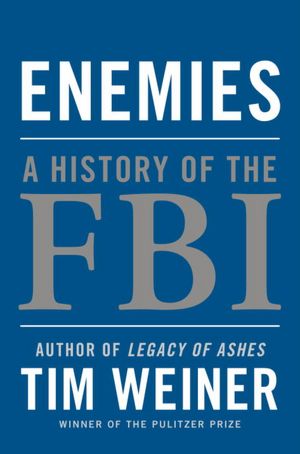
I'm having no luck finding a breezy book to try and match Becky's entries. OK, you win, it can't be done (No, I might be able to find a breezy book, but Becky has the patent on funny write-ups). So.... let's all read about J. Edgar Hoover and those zany guys at the FBI!
This is one heck of a story. Starts back with presidents from Lincoln on using private investigators to try and figure out what's going on inside the country and Teddy Roosevelt setting up a federal agency for the same purpose. They didn't bother with pesky things like a congressional charter (there still isn't one for the FBI) or too much oversight, because what they wanted to know normally couldn't be done with search warrants and lots of rules. This book really isn't about J. Edgar being a loose cannon. It's about every president wanting the kind of information those agencies (the FBI is only the most recent incarnation) could provide and J. Edgar doing a pretty good job of providing it.
When Nixon came on the scene, he was so far out on the paranoid edge as far as wanting info on everyone that even Hoover pulled back from him and Nixon created his own very poor spy organization (the Plumbers) with disastrous results. The fallout from Watergate hamstrung the agency, which is only now in a position to where rules exist to guide the FBI yet give them enough leeway to do the job. I got to the end of the book with hope that there can now be a balanced future between competent outcomes and infringement of personal liberties.
The is a real page-turner. There have been continuous instances of internal and external terrorists in the U.S. since the 19th century and this narrative puts them into context and actually changed some of my thinking on individual freedom vs. civic safety. The book does not focus on the federal law enforcement aspect of the agency but on intelligence gathering and how it has sometimes kept us safe and sometimes missed the boat. It's a great read and a wonderful historical perspective.
Showing posts with label Dave. Show all posts
Thursday, April 19, 2012
Thursday, March 01, 2012
The Thousand Autumns of Jacob De Zoet by David Mitchell
I've always had an interest in Japan, especially Japan prior to its being forced open in the mid-1800's. This story centers around 50 years prior to that time, when a young Dutch clerk seeks his fortune by going to the only place where foreigners are allowed in Japan, an artificial island in the bay of Nagasaki. He becomes infatuated with a Japanese woman who is a midwife and a student of the European doctor who tends to the Dutch East India Company residents of this foreign enclave.
I almost gave up on Jacob in the first third of the book because I thought he was a rigid naif among a nest of snakes and was hoping for more. I kept going because of the writing and the characters.
Friday, February 24, 2012
The Voyage by Philip Caputo
Could this picture be any bigger? Anyhow, thought I'd go big for my first post in a couple of years. Was going to try for funny, but Becky set the bar on that one for her first two, so I'll try my usual format and maybe stretch out with later posts.
"On a June morning in 1901, Cyrus Braithwaite orders his three sons to set sail from their Maine home aboard the family's forty-six-foot schooner and not return until September. Though confused and hurt by their father's cold-blooded actions, the three brothers soon rise to the occasion and embark on a breathtakingly perilous journey down the East Coast, headed for the Florida Keys. Almost one hundred years later, Cyrus's great-granddaughter Sybil sets out to uncover the events that transpired on the voyage. Her discoveries about the Braithwaite family and the America they lived in unfolds into a stunning tale of intrigue, murder, lies and deceit."
I copied that last paragraph from the Random House website. Couldn't have done better, so let's call this the sincerest form of flattery. About the book, I really liked it. The initial start with the great-granddaughter looking into a mystery was kind of clunky, but once the tale was fully enveloped with the three boys and the ship, it was as good as sea stories and coming of age stories get. The mystery is good, the clues make sense when presented, and all of the scenes of storms, animal or human attacks, and family dynamics really work. I had to put the book down a couple of times and mentally catch my breath after a few of those scenes. Caputo is a wonderfully clear and descriptive writer without being verbose. I know all the not-retired folks have time constraints, but this is writing at its best and worth the time.
Thursday, May 27, 2010
Major Pettigrew's Last Stand by Helen Simonson
As you know, if I don't like the main character at all, I'm unlikely to like the book, even if it's well written (see Snow & The Kite Runner). This book is the antithesis of those stories. Major Pettigrew is a retired, widowed British soldier, in love with his village and an England that is more fictional or historic than the current version. The death of his brother sets in motion a series of events that bring this wonderful gentleman's best self to the surface and let's us in on a thoroughly charming story. He handles the petty snobbery of English village life with a dry sense of humor that had me laughing out loud throughout the book. Having him encounter an unexpected love in his senior years was just icing on the cake. I love this guy and this book. A real triumph for a first time writer. All the blog readers should really like this one.
Tuesday, January 26, 2010
The Big Burn by Timothy Egan
Now this is a big picture. Don't know how it got that way, but it's fitting for the story being told. In 1910, a fire the size of Connecticut swept through parts of Idaho, Montana, Washington state, and the surrounding area. The newly minted Forest Service had the job of suppressing the fire, since the thoughts of the time were that mankind could control nature to a great degree. The Forest Service did not suppress the fire and yet that failure probably saved the service. The opponents were those U.S. Senators and Congressmen who opposed the service and the concept of national parks to meet the desires of the lumber, mining, and railroad barons of the day.This is a story similar to Egan's other book about the Dust Bowl. It's as big a topic with the added feature of bigger than life characters like Teddy Roosevelt and the interests who opposed him. The story of the fire itself is gripping and individual accounts very moving. In the end, though, what struck me most was the change in the parks themselves. They are not the pristine wildernesses envisioned by TR and people like John Muir and TR's chief forester, Gifford Pinchot nor are they resources only for the taking of big industry. Lessons learned from the Big Burn (do everything possible to suppress fires) also are no longer the established thinking. All told, the parks today probably are a more balanced approach to both saving and using public lands, but the debate is far from over. This book gives a nice background to the parks founding, their early turbulent years and where they stand today.
The book was a Christmas gift from Amanda and I believe all our readers would enjoy it.
Monday, August 10, 2009
The Elegance of the Hedgehog by Muriel Barbery
This is another Jackie recommendation. It is a story of the inhabitants of an upscale Paris apartment complex, with the focus being the concierge and one of the families that includes a younger daughter who does not fit in with the rest of her family. The concierge and the little girl have inner lives unapparent to the disinterested rest of the complex inhabitants. A new apartment occupant changes the dynamics of the complex and brings out the inner lives of the concierge and the girl.This is simple story telling in the vein of "To Kill A Mockingbird" but with a broader consideration of art and the meaning of life done without pretension. The concierge contemplates the point of art and philosophy as well and as concisely as anything I've encountered while making it a part of the story rather than the point of the story. I should have had a hi lighter in hand to mark those portions bearing repeating but it would have taken away from just reading a truly lovely story that I did not want to end.
Friday, July 17, 2009
Horse Soldiers by Doug Stanton
Jackie and I both read this and liked it. It's the story of a small band of Special Forces soldiers who entered Afghanistan shortly after 9/11 and worked with local, often competing, warlord factions to overthrow the Taliban and Al Qaeda in Afghanistan. You get to know the men and their training prior to deployment and then follow them as they move from Uzbekistan to Afghanistan via the worst helicopter ride you'll ever read about to the headquarters of one of the warlords. They lived with, and at the level of, the local fighters, which is to say they were very deprived and operated under extreme circumstances for long periods of time. It was touch-and-go near the end and could easily have resulted in a campaign that lasted years instead of months. We are a fortunate people to have those among us willing to live the life these Special Forces troops have chosen.For those who've read "The Kite Runner" and "Three Cups of Tea," this is a compliment to those views of life in Afghanistan. I got a stronger sense of just how widespread and evil the Taliban regime was and how complex Afghan society is. I'm not sure if the country can be governed as a republic in the same way as occurs in the U.S., but it sounds like our initial foray into that country started on the right foot and gave us a better chance as being viewed as liberators rather than conquerors.
Friday, July 03, 2009
The Last Lecture by Randy Pausch
Beckie sent this book for Father's Day and mentioned she thought of me while reading it. It was a thoughtful gift. You've probably read about this professor who only had a few months to live and gave a last lecture at his university. He had three small children and wanted to leave snippets of himself for them to access when they were older in addition to the video tapes of him interacting with them. The lecture and book focused on dreams he had as a boy and approaches to life he used to attain those dreams and live that life.Randy Pausch had a self-described large ego that came through in the book. I found it a little off-putting but in the end also thought he did a good job of weaving his life approaches into the narrative of giving the lecture and approaching the end of life. I also understand why Beckie thought of me because so many of the things he described as approaches to life have come out of my mouth and into the ears of Beckie and Amanda. Maybe the ego was there, too, which is a little disconcerting. He had more specific dreams for the future as a boy than most people I know and did a good job of attaining those dreams.
As a whole, you could do worse than following his advise for living a life. It's a quick and clear read that's worthwhile for all our blogger community. It also brings up the question of how you'd spend your last few months if you knew that was the limit. He made interesting choices with that question.
Sunday, May 10, 2009
The Nine by Jeffrey Toobin
As with many of the books here, Jackie read it first and suggested I'd like it. She's right. It concerns the history of the Rehnquist court, the longest running time in U.S. history when the same 9 judges sat on the court. He continues the book after Rehnquist's death until just before the '08 election.Toobin is a clear writer who handles this topic with judgement and as little bias as can be had considering some of the court's actions sometime call for expressions of outrage or confusion. It documents the steady drift to the right of that court and the self-leveling dynamics from within the court that allowed some justices who could have been considered right of center to move to the center for the sake of common sense. In the end, the steady focus of the extreme right that has taken over the Republican Party finally broke through with today's court being the result.
Perhaps the most interesting part of the book is the conclusion that there is no such thing as a judge who is not an activist. To have the hard core Constitutionalists judges like Thomas and Scalia vote for the Bush administration and against a specific portion of the original Constitution violating the Writ of Habeus Corpus and the skewing of power toward the executive branch just shows that politics speaks louder than the Constitution when it serves a judge's interests. This is a very good book but made me angry all over again reliving the 2000-08 time frame.
Monday, April 13, 2009
A Wild Sheep Chase by Haruki Murakami
Becky blogged on two books by Murakami and I tried finding them at the library and local book store, to no avail. However, there were a number of others available and I tried this one. From reading Becky's blogs, this book, and the synopsis of other books, Murakami has a consistent style. I liked it but it may not be for everyone.The story involves a late twenty-something man who's drifting through life and gets drawn into a mystery involving a sheep with mystical powers. There is a web of intrigue surrounding the sheep as well as time shifts along the way to add a back story to the main event. The fact that the author treats the idea of a sheep with powers in a serious manner gives you a sense of his underlying dry humor. Occasionally, there's almost a science fiction feel to some of the story. Some of the dialogue sounds like those you'd have in college late at night discussing stuff that might be alcohol-fueled and would be tedious if it weren't so much fun at the time. Now that the story has ended, I'm thinking of it a little to try filling in the blanks but I think the destination is not as important as the journey.
Amanda might like him, so try either this book or the Wind Up Bird Chronicles. I'll ask Becky to bring her copy of WUBC when she's here later in the year. I'd like to read more of Murakami but need some different authors in between.
Saturday, March 28, 2009
Gilead and Home by Marilynne Robinson
I'm reviewing these two books together because they are so interconnected. I actually read Gilead in 2004, the year it won the Pulitzer Prize, and reread it just a few weeks ago before I started Home. Robinson's prose is a joy to read...it is consistently beautiful, graceful and spiritual. The word elegiac, I think, best describes its tone. So, if you're in the mood for something light and cheerful, these are not the books for you right now. However, if you are in a more pensive state of mind, I think you will be swept away.Briefly, Gilead reads almost like a sermon on living life to the fullest. The narrative flows in the form of a long letter written by the aged and dying Reverend John Ames to his young son. Since he knows he won't live to see his son grow up he wants to leave the boy with an accurate accounting of his forebears and himself. As the son and grandson of preachers he describes how his grandfather went west to Kansas to fight abolition and "preached men into the Civil War". Rev. Ames also relates his own vision of life as a "wondrously strange creation". Woven throughout his narration is also a story about the deep, complicated and often strained bonds that exist between fathers and sons.
Ames spends a good deal of time discussing his long time friend, next-door neighbor and fellow preacher, Reverend Robert Boughton. Boughton's wayward son, Jack (he was named after Rev. John Ames) returns to Gilead in an attempt to make peace with his own dying father. Jack has always been Boughton's favorite child despite his long history of thievery, meaness, drunkeness and irresponsiblity. Ames also knew Jack as a child and has never liked or trusted him. And it is clear from Ames' musings that he is anxious and fearful of what Jack's intentions might be toward his (Ames') young wife and son after he is gone from this world. The sequel, Home, provides a tender counterpoint to this notion......
The story of Home is also set in Gilead (Iowa) and runs concurrently but in Reverend Boughton's household. As I mentioned earlier, Jack, Boughton's favorite son, returns home after a 20 year absence, hoping to make peace with his father but discovers that the old man is dying. The family's youngest child, Glory had recently returned to the family home to take care of her father in his final days. Since Jack had been run out of town in disgrace while Glory was still a child, the two are now almost like strangers to each other. But as the days and weeks unfold and their father's condition continues to decline, Jack and Glory begin to forge an intense bond with each other as they slowly and painfully reveal and begin coming to terms with some of the past regrets and painful secrets that continue to haunt them. Robinson describes Jack's awkward, yet loving and tender efforts to reconcile the tattered relationship with his father in such a way that, as a reader, I began to believe that he had changed. For Boughton, however, the effort comes too late as his mind gradually slips away.
Home (and Gilead) is "about families, family secrets, and the passing of generations, about love and death and faith...an unforgettable embodiment of the deepest and most universal emotions."(inside front flap) I thought these were compelling stories...and think you will too.
Friday, March 27, 2009
The Curious Incident Of The Dog In The Night-time by Mark Haddon
Amanda posted this review a little while back and thought I'd like it. Rather than just add a comment to her review and say "I liked it a lot" I thought I'd add this post to highlight the book.I liked it a lot.
Everything Amanda wrote is true. My add is that it is a sad and funny coming of age story for a young man who is coming of age under very difficult circumstances. His autism is only one of them. Yet through it all he is brave, interesting and a good detective. He also manages his issues well, given how large they are. Sometimes they break your heart. It's probably a mark of the quality of the story and the writing that, once I picked it up, it was done in about a day and a half. I think everyone will like this one... a lot.
Tuesday, March 24, 2009
The Stanger -and - The Plague by Albert Camus
I'm posting this review just to purge my system and get ready to start "the curious incident of the dog in the night-time." Amanda recommended that book and I'm pretty sure I'll like it. I'm starting it today.Why I decided to read Camus, I have no idea. He's one of those authors you are supposed to read to broaden your thoughts. I'd finished "In Cold Blood", an excellent book about senseless deaths and their aftermath. So what did I do? Read two more books about senseless death and its aftermath. Not a good idea at the tail end of winter. "Stori Telling" (or however it's spelled) is probably more recommended but the local book store didn't have it.
Anyhow, "The Stranger" involves a man who drifts through life, not really caring if he decides for or against any action, and ends up killing someone for no good reason. He's sentenced to death and may or may not be executed at the end of the book. There may or may not be a God, an afterlife, or meaning to any event other than its immediate utility. In "The Plague" the murderer is a disease that kills tens of thousands in the same meaningless environment. It's probably a thought to consider (if you haven't already), but you can just read this paragraph and skip the books to get the idea. Unlike "ICB" the writing was not compelling, even though the characters were reasonably lifelike and sometimes likable.
It was interesting reading a copy of "The Plague" that was Jackie's in nursing school. Turns out her dog ate nine pages just before the end of the book, plus a few paragraphs at the beginning. It didn't mater. I didn't know why the police were suddenly rushing an apartment building and dragging a man into the streets after just finishing the chapter where the plague has run its course and the city is about to be set free to resume its normal life. Had the pages been left in the book, I might not have understood why the man went crazy anyhow.
Any questions? Answer them yourself.
Wednesday, March 04, 2009
In Cold Blood by Truman Capote

Becky wrote about Breakfast At Tiffany's and I mentioned I'd never read "In Cold Blood" so she loaned me her copy. If there are any others in our circle who've not read it, I strongly recommend it.
As you probably know, it's the story of two men who kill a family of four in Kansas and how they subsequently were captured and executed. The "must read" aspect of the story is Capote's descriptive yet sparse writing and his empathy for everyone appearing in the story, including the murderers. It's not a bleeding heart empathy but rather a clear-eyed look at everyone involved and a lack of vindictive slant when it would be easy to do given the awful nature of the crime. The two murderers had different backgrounds and somewhat different psychological drivers leading to the murder but you feel as if you know them, the victims, lawmen, townspeople, and anyone else touched by the crime. It's also why we lock our doors while living in an area where almost nobody else locks theirs.
Wednesday, January 14, 2009
Lincoln - The Biography of a Writer by Fred Kaplan
Not another Lincoln bio. Aren't there like a million of them? Yep, give or take but this is different from any of the others I've read. The author answers the "why another" question with "...there is no modern study of the origin and development of Lincoln's literary sensibility and genius... Lincoln's reading in the textbooks and literary anthologies of his youth, the literature that helped shape his mind and his prose style, is an essential part of the story."Kaplan does a first rate job of looking at the available literature of Lincoln's youth, his favorite authors (especially poets) of his adulthood and the speeches by others who Lincoln admired and shows the echos of those sources in his famous and not so famous essays. Kaplan calls them essays rather than speeches because Lincoln almost never spoke extemporaneously. He laid out each formal speech in a tight format that made the point while allowing for inserted jokes and stories (mostly "earthy") as the situation dictated. He wrote decent poetry, made two of the best speeches by any politician ever and could well be called the political Mark Twain. Kaplan also focuses on areas skipped over by everyone else I've read, including his unhappy (and coerced?) marriage, his treatment of the Indians, and his alienation from his father. Lincoln's use of language and his personal philosophy of how honest language is a critical factor in presidential leadership brings into sharp focus why the presidential utterances of the last eight years have been such an unsatisfying experience and what contributed in great part to his (GWB) impotence as a leader. For anyone who is interested in Lincoln, this is a must read.
Friday, December 19, 2008
The Reader by Bernhard Schlink
Jackie read this years ago and recommended it. The story involves a German boy of 15 being seduced by an older woman and a quasi reunion years later. There is much more but it would take away from the reading to reveal the remaining plot.You know I take literary characters to heart and like a story more if I like the main character. In this case both Jackie and I are uncertain of how we feel about either the boy or the woman. They are both flawed. Although the woman's seduction of the boy and also actions she took prior to meeting the boy are worse on the surface than those of the boy, I found myself more sympathetic to the woman. There is a court scene where she asks a judge in her trial what he would have done in her situation. She didn't ask the question as a calculated move; she truly could not see other options that may have been available to her. The boy was cold in his relationships after parting from the woman and perhaps it was due to the affair or is just how he is. Regardless, he had the power to make a number of relationships better and did not.
The book is a sparely written 218 pages that could be finished in one day. If you are thinking of seeing the movie that is just arriving in theaters, read the book first. I can't tell if any of our bloggers will love this, hate this, or be in between. I think I'm in between.
Monday, November 24, 2008
The Black Swan by Nassim Taleb
I'm reviewing this book not because anyone else is likely to read it (it's a statistical discussion) but because I'll be referencing it in phone chats and notes hereafter. The title refers to how everyone can have an understanding of existence and a single observation can completely change that understanding. Every so often , that event also may have large consequences. In this case it was all Europeans being sure swans were only white because those were the only ones they had ever seen. After seeing a single Australian black swan, that theory of many centuries was shown to be wrong. The book's point is that we view most of our existence in the same way, as if it were a statistical bell curve. If X observations have not indicated our understanding is wrong, then the chances of it being wrong are so remote as to be almost impossible. However, most things in life do not conform to the bell curve and lack of proof of an outlier is not the same as proof of the model we have in our head. Most of life's processes, including economics, history, social sciences and even many scientific areas, do not correspond to a linear formula. The reason an idea or a scientific model becomes dominant is not due to the merits of the idea or model but to luck and social dynamics related to the herd instinct. Other ideas and models can be more accurate or "better" and die off for reasons not related to the idea or model. Even a formula that may work under restricted (and unnatural) constraints will spin out of control in a short time span because of unknown or misunderstood interactions. We see this yearly with government and scientific predictions that fall apart in weeks, months or a few years, yet react strongly to embrace the next prediction with fervor.
So what? Taleb feels we are living in a world of increasing black swans due to the increased complexity of our world. Since his area of expertise is economics (he was a Wall Street options trader, among other things) economics is his main focus. He wrote this book in the last half of 2006, yet one of his points is "...As if we did not have enough problems, banks are now more vulnerable to the Black Swan ...than ever before with "scientists" among their staff taking care of exposures. The giant firm J.P. Morgan put the entire world at risk by introducing in the nineties RiskMetrics, a phony method aiming at managing people's risks, causing the generalized use of (a) fallacy... Likewise, the government-sponsored institution Fanny Mae, when I look at their risks, seems to be sitting on a barrel of dynamite, vulnerable to the slightest hiccup. But not to worry: their large staff of scientists deemed these events "unlikely."'
Wow, did he nail that two years ahead of the event. So what do we do if many of these big events can happen without us being able to predict them and yet those events can substantially change our life?
Don't worry about the stuff you can't control. The fact that any of us lives is a statistical miracle. Enjoy it. Rely on the things you know through practical experience. Be conservative if the downside risk of a chance failure is more than you can live with. Conversely, if you are working in an area where minor variance can occasionally produce huge payouts, expose yourself to those circumstances as much as possible. The richest, or longest living, or healthiest (pick your desired category for existence) person got there by having the luck of being in the right place at the right time with the right gifts (good genes, the right parents, the right culture, etc.) and then the skills to exploit the situation. In the case of investing, Taleb figures we don't really know the odds of most investments working out, so he's ultraconservative with about 85% of his investments (government bonds) and then invests the other 15% in those areas where a single breakout could make him ultra rich e.g. some computer companies in the early '90s, yet if he guesses wrong the chance of all of the 15% of the investments being hugely bad are not very high.
If you do read the book, he's pretty pleased with himself and is not afraid to throw zingers at authority. It's a fun read and if you decide to skip most of the statistical discussion and take his word for it, there are some profound insights worth retaining.
Monday, November 10, 2008
The Life of Andrew Jackson by Robert Remini
I picked this up to fill in some gaps about American politics in the first half of the 19th century. It is an abridgement of a three book set that won the National Book Award in 1984.From the beginning, Jackson's life was an adventure. He fought in the Revolution at 13 and was orphaned in the same year. He fought duals, had a controversial romantic life, fought Indians and the British, and reshaped American political and governmental life. It is a life that a fiction script writer would risk criticism for inserting so many near-death experiences, national firsts and bigger than life characteristics. He is justifiably controversial for having elevated the presidency to its modern executive status, for moving almost all eastern native American tribes to lands west of the Mississippi, for balancing the budget for the first time since the Revolution, changing national banking practices, etc.
When I read about FDR last month I came away with mixed emotions due to his character flaws and strengths combined with some governmental successes. He pales in comparison to Jackson, both for his flaws, his strengths, and his governmental outcomes. What was most surprising was the many similarities to issues that were addressed in this last election. Jackson took actions that reminded me of Bush, except Jackson was more courageous and competent. He also took stands that Democrats would applaud, especially since he created the Democratic party. He probably reminds me most of Teddy Roosevelt but is a unique individual. You will not be bored with this story and will come away with an excellent understanding of people like Calhoun, Clay, Webster, J.Q. Adams, and those presidents who followed Jackson into the 1840's. A worthwhile read and one that will leave me thinking about a president's place in the American governmental triumvirate for a long time.
Monday, November 03, 2008
The Shape Shifter by Tony Hillerman
I thought I'd just give a short plug for Tony Hillerman, since he pasted away a little more than a week ago. This was his last book and I'd recommend the series. In brief, these books feature an older Navajo police lieutenant and a younger police sergeant who solve cases in reservation areas of the southwest tribes in Arizona, New Mexico, Colorado, and Utah. The FBI is responsible for handling felonies like murder and armed robbery, but often do not understand the underlying dynamics of those indian cultures. The two Navajo policemen do and often solve the cases by coming at them from another point of view and a different entry point, like a stolen pot or container of pine sap.Some of the most satisfying reading for me is to be immersed in a culture very different from my own and following an interesting human dilemma using points of view that blend the familiar human condition with the unique issues associated with a different culture. In his best books, Hillerman pulled it off well. If you want to get a feel for his writing, try some early books, although this one stands alone as a decent mystery.
Tuesday, September 23, 2008
Straight Man by Richard Russo
I have a dilemma. The Salmon Rushdi review referred to it as a hoot. "Straight Man" by Richard Russo, also is a hoot in a somewhat different way, so hoot needs clarification. A hoot is a combination of funny (from ironic to laugh-out-loud) and complex in a good way. Rushdi's book was ironic with a dense and outlandish plot. Russo's book is laugh out loud funny with a compelling plot that is only slightly outlandish. With that out of the way, let's continue. If you like "Empire Falls" or "Nobody's Fool" then you will like this book. For those who have not read either of the others, Russo gives you a man negotiating life's normal problems with humor and insight in a small town that has seen better days. In the case of "Straight Man" the town is equally down-and-out with the main character, William Henry Devereaux, Jr., being a college english professor with a wise-ass approach to life. The book hit close to home because WHD's dialogue sounds like what often goes through my head. It took a while to finally suppress most of the dialogue (but not the thoughts) because, as my father used to say, nobody likes a wise ass. In "Straight Man" many people do not like WHD for that reason. An equal number do like him because he is a funny, decent guy, but are exasperated by what looks like self-destructive behaviour. Most of the plot involves a week or so as he nears 50 and his wife is out of town. He's a man at war with himself but doesn't quite realize it. Following him to a satisfying conclusion is a fun ride through this interesting life. I'm pretty sure all of you will like this one.
Subscribe to:
Comments (Atom)