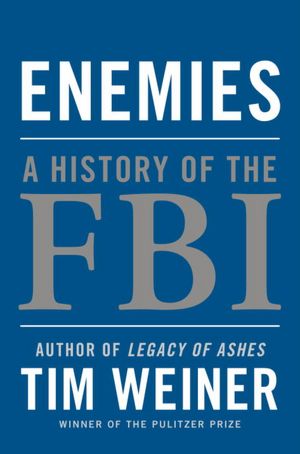
I'm having no luck finding a breezy book to try and match Becky's entries. OK, you win, it can't be done (No, I might be able to find a breezy book, but Becky has the patent on funny write-ups). So.... let's all read about J. Edgar Hoover and those zany guys at the FBI!
This is one heck of a story. Starts back with presidents from Lincoln on using private investigators to try and figure out what's going on inside the country and Teddy Roosevelt setting up a federal agency for the same purpose. They didn't bother with pesky things like a congressional charter (there still isn't one for the FBI) or too much oversight, because what they wanted to know normally couldn't be done with search warrants and lots of rules. This book really isn't about J. Edgar being a loose cannon. It's about every president wanting the kind of information those agencies (the FBI is only the most recent incarnation) could provide and J. Edgar doing a pretty good job of providing it.
When Nixon came on the scene, he was so far out on the paranoid edge as far as wanting info on everyone that even Hoover pulled back from him and Nixon created his own very poor spy organization (the Plumbers) with disastrous results. The fallout from Watergate hamstrung the agency, which is only now in a position to where rules exist to guide the FBI yet give them enough leeway to do the job. I got to the end of the book with hope that there can now be a balanced future between competent outcomes and infringement of personal liberties.
The is a real page-turner. There have been continuous instances of internal and external terrorists in the U.S. since the 19th century and this narrative puts them into context and actually changed some of my thinking on individual freedom vs. civic safety. The book does not focus on the federal law enforcement aspect of the agency but on intelligence gathering and how it has sometimes kept us safe and sometimes missed the boat. It's a great read and a wonderful historical perspective.
Showing posts with label Historical Non-Fiction. Show all posts
Thursday, April 19, 2012
Friday, February 24, 2012
The Voyage by Philip Caputo
Could this picture be any bigger? Anyhow, thought I'd go big for my first post in a couple of years. Was going to try for funny, but Becky set the bar on that one for her first two, so I'll try my usual format and maybe stretch out with later posts.
"On a June morning in 1901, Cyrus Braithwaite orders his three sons to set sail from their Maine home aboard the family's forty-six-foot schooner and not return until September. Though confused and hurt by their father's cold-blooded actions, the three brothers soon rise to the occasion and embark on a breathtakingly perilous journey down the East Coast, headed for the Florida Keys. Almost one hundred years later, Cyrus's great-granddaughter Sybil sets out to uncover the events that transpired on the voyage. Her discoveries about the Braithwaite family and the America they lived in unfolds into a stunning tale of intrigue, murder, lies and deceit."
I copied that last paragraph from the Random House website. Couldn't have done better, so let's call this the sincerest form of flattery. About the book, I really liked it. The initial start with the great-granddaughter looking into a mystery was kind of clunky, but once the tale was fully enveloped with the three boys and the ship, it was as good as sea stories and coming of age stories get. The mystery is good, the clues make sense when presented, and all of the scenes of storms, animal or human attacks, and family dynamics really work. I had to put the book down a couple of times and mentally catch my breath after a few of those scenes. Caputo is a wonderfully clear and descriptive writer without being verbose. I know all the not-retired folks have time constraints, but this is writing at its best and worth the time.
Tuesday, January 26, 2010
The Big Burn by Timothy Egan
Now this is a big picture. Don't know how it got that way, but it's fitting for the story being told. In 1910, a fire the size of Connecticut swept through parts of Idaho, Montana, Washington state, and the surrounding area. The newly minted Forest Service had the job of suppressing the fire, since the thoughts of the time were that mankind could control nature to a great degree. The Forest Service did not suppress the fire and yet that failure probably saved the service. The opponents were those U.S. Senators and Congressmen who opposed the service and the concept of national parks to meet the desires of the lumber, mining, and railroad barons of the day.This is a story similar to Egan's other book about the Dust Bowl. It's as big a topic with the added feature of bigger than life characters like Teddy Roosevelt and the interests who opposed him. The story of the fire itself is gripping and individual accounts very moving. In the end, though, what struck me most was the change in the parks themselves. They are not the pristine wildernesses envisioned by TR and people like John Muir and TR's chief forester, Gifford Pinchot nor are they resources only for the taking of big industry. Lessons learned from the Big Burn (do everything possible to suppress fires) also are no longer the established thinking. All told, the parks today probably are a more balanced approach to both saving and using public lands, but the debate is far from over. This book gives a nice background to the parks founding, their early turbulent years and where they stand today.
The book was a Christmas gift from Amanda and I believe all our readers would enjoy it.
Friday, July 17, 2009
Horse Soldiers by Doug Stanton
Jackie and I both read this and liked it. It's the story of a small band of Special Forces soldiers who entered Afghanistan shortly after 9/11 and worked with local, often competing, warlord factions to overthrow the Taliban and Al Qaeda in Afghanistan. You get to know the men and their training prior to deployment and then follow them as they move from Uzbekistan to Afghanistan via the worst helicopter ride you'll ever read about to the headquarters of one of the warlords. They lived with, and at the level of, the local fighters, which is to say they were very deprived and operated under extreme circumstances for long periods of time. It was touch-and-go near the end and could easily have resulted in a campaign that lasted years instead of months. We are a fortunate people to have those among us willing to live the life these Special Forces troops have chosen.For those who've read "The Kite Runner" and "Three Cups of Tea," this is a compliment to those views of life in Afghanistan. I got a stronger sense of just how widespread and evil the Taliban regime was and how complex Afghan society is. I'm not sure if the country can be governed as a republic in the same way as occurs in the U.S., but it sounds like our initial foray into that country started on the right foot and gave us a better chance as being viewed as liberators rather than conquerors.
Wednesday, March 04, 2009
In Cold Blood by Truman Capote

Becky wrote about Breakfast At Tiffany's and I mentioned I'd never read "In Cold Blood" so she loaned me her copy. If there are any others in our circle who've not read it, I strongly recommend it.
As you probably know, it's the story of two men who kill a family of four in Kansas and how they subsequently were captured and executed. The "must read" aspect of the story is Capote's descriptive yet sparse writing and his empathy for everyone appearing in the story, including the murderers. It's not a bleeding heart empathy but rather a clear-eyed look at everyone involved and a lack of vindictive slant when it would be easy to do given the awful nature of the crime. The two murderers had different backgrounds and somewhat different psychological drivers leading to the murder but you feel as if you know them, the victims, lawmen, townspeople, and anyone else touched by the crime. It's also why we lock our doors while living in an area where almost nobody else locks theirs.
Monday, December 01, 2008
The Wordy Shipmates by Sarah VowellI've read two of Vowell's previous books: "Assasination Vacation" and "The Partly Cloudy Patriot" and LOVED them, so I was really looking forward to this one. And it didn't disappoint. This one is a little less funny, though, what with all the Native American slaughter and such.
Relying heavily on John Winthrop's journals and famous sermon "A Model of Christian Charity" as a worldview lens, Vowell takes the reader on an eye-opening tale of the founding of the Massachussetts Bay colony. She interweaves Winthrop's story with those of John Cotton, Anne Hutchinson, and John Williams, among others.
What I found most interesting about this history was the contradiction between our Puritan founders' ideals and those of most modern Americans. In fact, evangelical Christians, who seem to stake a claim as the voice of "our nation's Christian founders", probably diverge from the Puritans ideals most of all (although many might agree with the "eye for an eye" justice meted out in Puritan courts!) Vowell dives to the depths of Puritan theology and how that worldview shaped everything in their lives, encompassing both their charity (sharing with one another) and ruthlessness (burning Indian women and children alive.) It's a complex, brutal, and ultimately, enlightening story about some of the founders of this complex, brutal, and enlightening nation. A must read.
Monday, August 25, 2008
No Ordinary Time

Okay, I know...another biography. I admit I'm hooked. I actually started reading this book about 10 years ago but it just didn't grab me. So, after all this time I decided to give it another try and I'm glad I did. It was well worth the investment of time and effort (all 635 pages). Doris Kearns Goodwin (Team of Rivals) is a clear and concise writer and, in this case has written a compelling and informative story, subtitled, Franklin and Eleanor Roosevelt: The Home Front in World War II.
As a child growing up in post- WWII America, the nation was still basking in the afterglow of the FDR presidency. It was a time of great national pride and growing prosperity after winning "the war". Although FDR had died in 1945 during his fourth term in office (can you imagine if we had GWB around that long?!!), his legacy was (and is) legion. Eleanor Roosevelt also remained a popular and much admired public figure, often appearing on television (a new media source in the 50s) to make public service announcements. After reading this book I have a much greater understanding of what it must have been like to have lived during "the war" and some of this nations darkest hours. I also gained a deeper appreciation for the contributions and sacrifices made by both Franklin and Eleanor during this critical and historic time. Franklin, an eternal optimist and Eleanor, a poster-child for civil rights and social justice, formed an unlikely, yet powerful partnership.
I thoroughly enjoyed this book and recommend it to anyone who wants to know more about America's role in WWII. In summary, Doris Kearns Goodwin writes, "the Roosevelt years had witnessed the most profound social revolution in the country since the Civil War- nothing less than the creation of modern America.
Friday, July 11, 2008
1421 by Gavin Menzies
Here goes another history like "Guns, Germs and Steel." The premise is that all the Europeans who we've been taught discovered the routes to Africa, the Americas, Australia, Antarctica and the North Pole were not the first to do so. A giant fleet of hundreds of ships sent by the emperor of China in 1421 to map all the unknown worlds accomplished all those feats, sometimes as much as 300 or more years before Europeans followed in their wake. In addition, although the Europeans were brave men who accomplished their voyages at great risk, it was not without prior knowledge. Prince Henry the Navigator had maps made in the 1420's and beyond based on Chinese maps that accurately showed Africa, the Americas, Australia, Antarctica and the far east. Columbus, Magellan, and the other Portuguese and Spanish explorers mention in their ship's logs and diaries that the places they encountered were where they were supposed to be according to those maps. Columbus's reporting errors back to the Spanish of having found China make sense when viewed in context. He had lied to the Spanish royalty that a quicker route to China could be accomplished going west while the Portuguese were going to China around Africa. If the Spanish, who did not know about the maps (but Columbus did) had thought the Portuguese would get there first, the Spanish would not have funded Columbus's journey. In addition to already knowing the route based on Chinese maps, all of the explorers mentioned encountering Chinese or Chinese goods in all those places. It appears that as Chinese ships wrecked in these various places, crews were left in place to set up colonies until future fleets could return to relieve them. DNA from tribes in the Americas, including the Sioux, the Navajo, some in the northeast U.S., plus Central and South America show Chinese ancestry. Even peoples who come from far northern Norway have the southeastern Chinese DNA. Tribes in Peru and on the North American west coast spoke and dressed as Chinese when first encountered by Spanish explorers and priests. The evidence of first contact by the Chinese prior to European exploration is massive, with over 1000 articles and books worldwide written over many decades on different aspects of the subject.
So how come we never heard about this in school. It turns out that when the fleet returned to China, rather than receiving a hero's welcome, they found that the old emperor was dying and the new emperors thereafter wanted nothing further to do with foreign trade and travel. That deep ocean travel and trade had been going on for at least 800 years up to that point. They ordered all maps and writings about the global trek to be destroyed. The deep water ships then in existence were to be destroyed or left to rot and the extensive trading system in the Pacific and Indian Oceans to be all but ended. However, sailors and merchants from other countries, including at least one European had sailed with the fleet for large segments of the journey and recorded their experiences. At least one of the Europeans made his way back to the map making center of Europe and is the probable source for the information on the maps used by Prince Henry.
The same strengths and weaknesses of "Guns, Germs, and Steel" are present in this book. The way that the story is pieced together is interesting and well done. However, the use of the personal pronoun "I" appears with too much frequency. A good rule of thumb in business writing is to never use any personal pronouns; once every 50 to 100 pages is about right in any other literary form other than fiction. The author's self reference is defensible because he takes on such a major paradigm shift in how historic oceanic exploration is currently taught that a little self-defensive rhetoric is understandable. However, it increases near the end of the book and makes the argument more strident than necessary. If you don't become too wrapped up in the names of the Chinese emperors and admirals and in geometric discussions of solving for latitude and longitude, the story flows well. It's a good read and the author makes his case. Once again "history as it's taught in school is bunk."
Thursday, May 22, 2008
Thunderstruck by Erik Larson

As in Larson's earlier book, The Devil in the White City, this one also intertwines the true stories of two unlikely characters. In Thunderstruck, Guglielmo Marconi and Hawley Crippen are the two men whose lives intersect in the early years of the 20th c.
Crippen was a mild-mannered doctor, who committed the second most famous murder in London (after Jack the Ripper). When his flamboyant, demanding and extravagant wife, Belle, mysteriously disappears her friends suspect him but the police can't find any evidence to hold him and he quietly leaves London with his secretary/lover, headed to America.
The other story describes Marconi's plodding and unscientific efforts to create the equipment that used electromagnetic waves to send wireless transmissions across the Atlantic. Larson goes into a bit too much detail here describing the relentless competition among the various "inventors" who were vying to be the first to master wireless technology. The fact that Marconi even succeeded at all is actually quite amazing because he really didn't understand how or why the equipment worked. For me, this was the most fascinating part of the book...
But in the end, the two mens' stories intersect when Marconi's wireless "invention" is the tool used by the London police track down and capture Crippen (after they did some digging in the garden of his former house), as he sailed across the Atlantic on the SS Montrose, ready start a new life in America. Oops, not so fast Mr. Crippen!
Crippen was a mild-mannered doctor, who committed the second most famous murder in London (after Jack the Ripper). When his flamboyant, demanding and extravagant wife, Belle, mysteriously disappears her friends suspect him but the police can't find any evidence to hold him and he quietly leaves London with his secretary/lover, headed to America.
The other story describes Marconi's plodding and unscientific efforts to create the equipment that used electromagnetic waves to send wireless transmissions across the Atlantic. Larson goes into a bit too much detail here describing the relentless competition among the various "inventors" who were vying to be the first to master wireless technology. The fact that Marconi even succeeded at all is actually quite amazing because he really didn't understand how or why the equipment worked. For me, this was the most fascinating part of the book...
But in the end, the two mens' stories intersect when Marconi's wireless "invention" is the tool used by the London police track down and capture Crippen (after they did some digging in the garden of his former house), as he sailed across the Atlantic on the SS Montrose, ready start a new life in America. Oops, not so fast Mr. Crippen!
Monday, May 07, 2007
The Worst Hard Time by Timothy Egan
This was Dave's Christmas gift from Amanda and we both read it (thanks Amanda)so I'll be the first one to review it.
This book should serve as a clarion call to all the naysayers who refuse to recognize the urgency of global warming in our world today. The book recounts one of this nation's worst environmental disasters- the dust storms that devastated the High Plains during the 1920-30s. At it's peak, the Dust Bowl covered 100 million acres and the dust darkened skies as far away as Manhattan! The Plains were a barren landscape, covered by tall grass, where the Native Americans had hunted bison for centuries. Thanks to the Homestead Act (1850s?)the U.S. government moved the Indians off the land and encouraged settlers to move west, promising them free land for farming (160 acres). The railroads, politicians, banks and newspaper editors also played a role according to Mr.Egan. He writes, "The flattest, driest, most wind-raked, least arable part of the United States was transformed by government incentive, private showmanship, and human desire from the Great American Desert into Eden with a haircut."
This is truly an amazing tale, told through the voices of people who actually lived through the dust bowl days. It is a story of government incompetence (sound familiar?), greed, ignorance, and denial that things were really as bad as they seemed. I couldn't help but see parallels with what is happening today as we experience climate change and hear the dire warnings about what that portends for life on Earth.
I highly recommend this book to anyone who cares about protecting the environment. The summation on the back cover says it best: "In an era that promises ever-greater natural disasters, The Worst Hard Time is a powerful cautionary tale about the dangers of trifling with nature."
Hi - This is Dave adding to Jackie's post. I'm afraid my comments are pessimistic. Each reading of a new book on the subject of global land use seems to suggest a poor outcome. A suggested additional companion piece to "The Worst Hard Time" (WHT)is "COLLAPSE - How Societies Choose To Fail or Succeed" by Jared Diamond. The book is a little problematic in tying the whole story together, but the conclusions seem reasonably well supported.
WHT & Collapse seem to deal with an environmental issue more dire than global warming. WHT described an expanding population moving to marginal land and succeeding in good times and damaging the land to the point it could no longer be used (or it disappeared in the case of the Dust Bowl) in bad times.
Collapse saw peoples either move away or starve and disappear under similar circumstances across time in different areas around the world. Globally, we appear to be at the point where many lands can not sustain the existing population with easily predicted climatic variances like weather events and temperature & rain fluctuations. The case gets worse with an increase in population. In the U.S., we still have a lot of land that appears to be ripe for occupation, but is marginal. Think lowlands (New Orleans, coastal regions including NYC, river flood plains), arid lands (the central high plains, high lands above 3-4,000 feet, or lands serving a cleansing purpose like forests and wet lands. Resource practices (high consumption in U.S., Europe, Japan; lesser rates in rest of world) also have a large effect and the trend is bad. Developing countries aspire to the U.S. consumption model. Collapse estimates we can maybe double the world's population with all known resources and at current consumption rates. If the current global population consummed as the U.S. does, we wouldn't have enough resources to live at the current 6 billion person level. It suggests that the developed nations need to use far fewer resources than today because the rest of world will catch up to that rate in a short time. It also suggests the global population should stop growing. A global discussion on consumption and population appears to be the most pressing environmental issue (not global warming) but is unlikely to occur until the predictable conflicts over water, food and habitable land occur multiple times and the root causes become more apparent. Like I said, my conclusions (most of the preceding paragraph) are pessimistic but that should not take away from reading either WHT or Collapse. The better we understand the known situation, the greater chance we have of producing a better outcome.
This book should serve as a clarion call to all the naysayers who refuse to recognize the urgency of global warming in our world today. The book recounts one of this nation's worst environmental disasters- the dust storms that devastated the High Plains during the 1920-30s. At it's peak, the Dust Bowl covered 100 million acres and the dust darkened skies as far away as Manhattan! The Plains were a barren landscape, covered by tall grass, where the Native Americans had hunted bison for centuries. Thanks to the Homestead Act (1850s?)the U.S. government moved the Indians off the land and encouraged settlers to move west, promising them free land for farming (160 acres). The railroads, politicians, banks and newspaper editors also played a role according to Mr.Egan. He writes, "The flattest, driest, most wind-raked, least arable part of the United States was transformed by government incentive, private showmanship, and human desire from the Great American Desert into Eden with a haircut."
This is truly an amazing tale, told through the voices of people who actually lived through the dust bowl days. It is a story of government incompetence (sound familiar?), greed, ignorance, and denial that things were really as bad as they seemed. I couldn't help but see parallels with what is happening today as we experience climate change and hear the dire warnings about what that portends for life on Earth.
I highly recommend this book to anyone who cares about protecting the environment. The summation on the back cover says it best: "In an era that promises ever-greater natural disasters, The Worst Hard Time is a powerful cautionary tale about the dangers of trifling with nature."
Hi - This is Dave adding to Jackie's post. I'm afraid my comments are pessimistic. Each reading of a new book on the subject of global land use seems to suggest a poor outcome. A suggested additional companion piece to "The Worst Hard Time" (WHT)is "COLLAPSE - How Societies Choose To Fail or Succeed" by Jared Diamond. The book is a little problematic in tying the whole story together, but the conclusions seem reasonably well supported.
WHT & Collapse seem to deal with an environmental issue more dire than global warming. WHT described an expanding population moving to marginal land and succeeding in good times and damaging the land to the point it could no longer be used (or it disappeared in the case of the Dust Bowl) in bad times.
Collapse saw peoples either move away or starve and disappear under similar circumstances across time in different areas around the world. Globally, we appear to be at the point where many lands can not sustain the existing population with easily predicted climatic variances like weather events and temperature & rain fluctuations. The case gets worse with an increase in population. In the U.S., we still have a lot of land that appears to be ripe for occupation, but is marginal. Think lowlands (New Orleans, coastal regions including NYC, river flood plains), arid lands (the central high plains, high lands above 3-4,000 feet, or lands serving a cleansing purpose like forests and wet lands. Resource practices (high consumption in U.S., Europe, Japan; lesser rates in rest of world) also have a large effect and the trend is bad. Developing countries aspire to the U.S. consumption model. Collapse estimates we can maybe double the world's population with all known resources and at current consumption rates. If the current global population consummed as the U.S. does, we wouldn't have enough resources to live at the current 6 billion person level. It suggests that the developed nations need to use far fewer resources than today because the rest of world will catch up to that rate in a short time. It also suggests the global population should stop growing. A global discussion on consumption and population appears to be the most pressing environmental issue (not global warming) but is unlikely to occur until the predictable conflicts over water, food and habitable land occur multiple times and the root causes become more apparent. Like I said, my conclusions (most of the preceding paragraph) are pessimistic but that should not take away from reading either WHT or Collapse. The better we understand the known situation, the greater chance we have of producing a better outcome.
Saturday, February 03, 2007
Team Of Rivals
Here's my first try at a posting. I was given this book by Mark (good choice!) on my last work day at Ford. I've read other books about Lincoln and thought the view of the times through the lives of his cabinet members would make for a good read. Wow, what an understatement!
Doris Kearns Goodwin weaves the life stories of the major political figures that came to form the Republican Party into a culminating event at the party convention preceding the 1860 presidential election. By the time Lincoln selects his cabinet from all those disperate men in the midst of the disintigrating union, the book is about half done. The remainder of the 754 pages moves through the war and the aftermath of Lincoln's death.
As is the case with all good histories, you get to know enough about the people and the times to make comparisons to today. There are major differences from today in how policy was publically discussed, since political debates were a major source of entertainment and important speeches were printed in partisan papers throughout the country. However, the parocial bickering and nasty personal attacks of the day appear to be more mean spirited and inaccurate than anything Rush Limbaugh or Fox News doles out today.
The author gives a sense that you've discovered the essense of each important figure, at least as it relates to their political actions before and after the election and the war. Most important for me was how Lincoln handled these men and everyone else with whom he came into contact. He had about 1 1/2 years of "in class" education with everything else coming from a continual reading of books on every subject imaginable. For an example, he taught himself geometry by working out difficult proofs while practicing law in Springfield. For almost everyone who came into contact with him, except for those blinded by their own egos, the initial impression was of an affable country bumpkin and ended with the thought that he was perhaps one of the most able, complex and decent men to ever have held that, or any other, office.
Goodwin has a very clear, logical and engaging writing style. If you have the time, it will draw you into the story for large periods of time. Even if you read like I do sometimes, with the TV on and doing a puzzle, you still can make steady progress and enjoy the process a great deal.
Doris Kearns Goodwin weaves the life stories of the major political figures that came to form the Republican Party into a culminating event at the party convention preceding the 1860 presidential election. By the time Lincoln selects his cabinet from all those disperate men in the midst of the disintigrating union, the book is about half done. The remainder of the 754 pages moves through the war and the aftermath of Lincoln's death.
As is the case with all good histories, you get to know enough about the people and the times to make comparisons to today. There are major differences from today in how policy was publically discussed, since political debates were a major source of entertainment and important speeches were printed in partisan papers throughout the country. However, the parocial bickering and nasty personal attacks of the day appear to be more mean spirited and inaccurate than anything Rush Limbaugh or Fox News doles out today.
The author gives a sense that you've discovered the essense of each important figure, at least as it relates to their political actions before and after the election and the war. Most important for me was how Lincoln handled these men and everyone else with whom he came into contact. He had about 1 1/2 years of "in class" education with everything else coming from a continual reading of books on every subject imaginable. For an example, he taught himself geometry by working out difficult proofs while practicing law in Springfield. For almost everyone who came into contact with him, except for those blinded by their own egos, the initial impression was of an affable country bumpkin and ended with the thought that he was perhaps one of the most able, complex and decent men to ever have held that, or any other, office.
Goodwin has a very clear, logical and engaging writing style. If you have the time, it will draw you into the story for large periods of time. Even if you read like I do sometimes, with the TV on and doing a puzzle, you still can make steady progress and enjoy the process a great deal.
Labels:
A Good Read,
Dave,
Historical Non-Fiction,
Non-Fiction
Subscribe to:
Posts (Atom)