This is a tough book to review. I've read other reviews of the book to look for a way in and most folks say the same thing; best book they've read this year, a fantasy story of a sort because it contains two mythical creatures, a serious piece of literature that deals with life issues well without focusing on those issues rather than the story, a great historical novel, a love story.
Those ideas give you a hint at this book but they still don't quite capture it. A Golem is a creature from Hebrew mythology that is made of clay and brought to life through an incantation to serve as a slave to one master. A Jinni (there are many types) is a creature of fire from Arabic mythology that does not willingly become a slave but can be captured by a wizard and made to perform tasks and grant wishes. In this story, both are brought to the tenements of lower Manhattan around 1900 and set free in a way. They struggle to make their way in the respective Jewish and Arabic communities with the help of one human in each community who understands what they are and decides to be a mentor. Inevitably they meet and understand they are in the presence of an "other" like them. The story has a flow that constantly draws you in and along, with every character, no matter how minor, being well drawn and true to life. The twists and turns were interesting and I did not see most of them coming. The conclusion was satisfying (for me) and did not seem contrived, and I could not have told you the ending even when I was ten pages from the end.
This is a wonderful achievement for any author and stunning for this first time author. It is as good as any book by Terry Pratchett or Neil Gaiman and can be favorably compared to any novel I've read in the last number of years, regardless of genre. It is fantasy in the way Salman Rushdie is fantasy but is more accessible and better plotted. I recommend it to everyone.
Sunday, August 11, 2013
Thursday, August 08, 2013
Detroit by Charlie LeDuff
As a Michigan native, I was drawn to
this book because I, like so many others around the country, are morbidly
fascinated with the city of Detroit. Growing up, we went there for Tigers games
and the art museum, for a bite to eat and a show at the Fox theater a few times
a year, if that. But we didn’t shop there, we didn’t walk downtown, we didn’t
frequent any parks or marvel at the skyscrapers.
And we didn’t do any
of those things because you can’t do those
things in downtown Detroit.
I have friends who
are hardcover Detroit City lovers, and I am too, in a way. But I’m not naïve and
I’m not blind to the realities of what is happening and has happened there over
the last five decades or so. It’s one thing to get excited for the potential
that it holds – the young artists and entrepreneurs who are and have been
moving in over the last few years, the first mayor in more than thirty years who
actually seems to give a crap about the city and its future.
But Detroit went
bankrupt for a reason, you guys, and it’s no clearer than when you read Charlie
LeDuff’s portrait of this crumbling American city, once thriving under the car
industry and booming with promise.
Get ready, though, because he doesn’t paint a pretty
picture. He’s not looking at Detroit through the lens of an optimistic artist.
He describes frozen corpses, burning houses, corrupt, thieving politicians,
strung-out derelicts, and murdered
children. And he points out that these occurrences are as common and as
unremarkable to the jaded citizens of Detroit as the Empire State Building
changing colors every day is to New Yorkers.
But it was a book I’m so glad I read and one that gave me
both perspective and odd hope for the city that once was. LeDuff paints a grim
picture, but he does it through stories laced with facts, both good and bad - as any good
journalist does.
The only criticism I have of the book as a whole is that it’s
one of those that you really have to be in the right mood to read – there were
times I’d pick it up, read a few pages, and put it down because it just wasn’t
gelling. And then there were other days where I couldn’t put it down.
So, I’d highly recommend this to anyone in the family (and
outside of it), but maybe also have something a little more upbeat to jump to (like
Stories About My Underpants!)
when the going gets tough and Kwame Kilpatrick kills another prostitute.
Just sayin’.
Happy reading!
Friday, August 02, 2013
A Delicate Truth by John LeCarre
Spy stories vary but seem to fall roughly into two categories. The most common at the moment is the person on a mission who's allowed to kill people, often with new-age gadgets (Bond) or the person with super-human abilities who also ends up killing lots of people (Bourne). In the other camp are mostly normal human beings leading supposedly normal lives but who are actually spying, which might sometimes involve violence. This second group has David Cornwell (pen name John LeCarre) producing books that feel very real. It's probably because he was part of the English equivalent of both our FBI and CIA. He doesn't seem to like those groups, especially the CIA, but has his Englishmen muddle through under murky circumstances to an often inconclusive end. If you've read "Smiley's People" or "Tinker, Taylor, Soldier, Spy" and like his characters and multiple person focus to telling the story, then this book is for you.
In "A Delicate Truth" Cornwell mines the most current situation, which involves using private contractors to do work that used to be done by intelligence agencies. Since it's a lucrative field, corruption lurks in the background and cover-up can be the outcome, especially if something goes wrong. It does. The resulting desire to do the right thing, which often depends on your point of view, propels a ripping good yarn that I think is one of his best.
The author's use of the English class consciousness and old boy network can be grating to an American reader, but it feels real. His disdain for the CIA and apparently Americans in general may at least stem partially from working with those folks during the late '50s and '60's when the CIA did a lot of government overthrow but was less successful in actually gathering secret data and making good analysis. In fairness, the English had their share of spies high in their MI6 who were working for the USSR, so nobody comes out clean in reviewing the history of espionage. If you like that clear eyed view of the genre, then read this book.
Thursday, August 01, 2013
The Dog Stars by Peter Heller
This is a first novel by outdoor magazine writer Peter Heller about those who inhabit what was once the state of Colorado after a devastating flu epidemic some decades from now. This is not "The Road", with its most bleak of depictions of a post apocalyptic world, but it is mostly populated with people living in a kill or be killed existence.
That description is probably enough for many to stop and not bother with the book. However, the upside is a compelling story interspersed with lyrical writing about hunting and fishing, flying, and a man's relationship with his dog. The writing style is different, with a quasi-stream-of-consciousness rambling whenever you are inside his mind. Heller could work on that some but I got into the rhythm and didn't notice after a while.
I've thought a lot about this book since reading it last month and think Becky would like it and know that Jackie already does since she read it as well. If you skip over the idea that this fellow probably should have been killed off early on because he was and still is hesitant to just kill anyone who's still around, then the story works well enough and really moves along the farther you get into it. At about 250 pages, it's a quick read and worth giving a try.
Friday, July 19, 2013
Legacy of Ashes by Tim Weiner
A while back I posted another Tim Weiner book about the FBI called "Enemies." It was so good I decided to read this one, which preceded "Enemies." Like "Enemies" he takes a government institution and opens it up using the organization's own files plus many interviews. In this case, it's the CIA.
Now you'd think that working with the CIA files would get you several tons of paper with most of the words blacked out. However, so much previously classified documentation got declassified in the 90's and people were willing to speak on the record, this book only contains verified accounts, with no hidden sources or other obfuscations.
The main reason this is being added to the blog is the flood of recent discussions about current CIA clandestine paramilitary operations. Part of that discussion makes it sound as if this is a new thing. As this book points out, those types of operations constituted the majority of the CIA activities from the late 1940's onward, often to the detriment of actual spying and compiling intelligence information from the many U.S. agencies that collected their own covert information, including the military and the State Department. The result was the overthrow of a lot of foreign governments in the 50's and 60's, but poor coordination of intelligence coming into the country. The ultimate result was 9/11.
The current discussion around personal privacy reveals that many people hope there actually is some professional government agency that has the capability to put all the pieces together and find and stop bad guys while letting the rest of us live our lives unmolested. That's a pretty tall order and is subject to abuse. In this case, the CIA did such a poor job of collecting and diagnosing intelligence that the responsibility was taken away from them in 2005 when the Office of Central Intelligence was dissolved. They still are doing paramilitary operations. I hope they've been able to retain veteran and recruit high-quality new individuals who can do the difficult work of acquiring secret knowledge and putting all those pieces together. In "Enemies" I came away hopeful that issues were being addressed and resolved in the FBI to give us an internal surveillance and protection organization that can address issues of the 21st century. In "Legacy..." I'm not so sure we have that capability on a global scale. If you liked "Enemies" you'll like this book but you may be less optimistic with the ending.
Wednesday, July 17, 2013
The Forest Unseen by David George Haskell
You know how you watch a really good nature program and the narrator points to something growing on the ground and then ties it to some bird who dropped something that nature made it pick up in the first place ten miles away? After a while you start to understand that this area has microbes, insects, birds, winds in the trees that effect leaves shaped just so, etc. and it's all tied together and you think "Holy cow, that's amazing!" Well, this book is that show and then some.
David Haskell is a biology professor who I really wish I'd had as my high school biology teacher. Haskell decided to stake out a little plot in a Tennessee forest about a meter square and watch it every day for a year to see what he could see. He likened it to a Tibetan monk's sand painting in which all the universe could be witnessed within. Seeing the whole universe might be a stretch, but you get a good sense of the interconnectedness of living things on earth in these beautifully written vignettes. Each chapter is around 6 pages long and represents a day's observations and thoughts on those sights. They're all good and some of them are really cool. It flows, makes sense and is lyrical to boot. I would read one or two of the days and put it down, only to pick it up again pretty soon to see what was next. The book is 245 pages with footnotes added if you want to dive a little deeper into that particular day or fact.
We don't see most of what is around us. It's there and our senses pick it up but we filter it out and move ahead. Professor Haskell does a beautiful job of gently pulling us back to our world and seeing it with fresh eyes.
Friday, May 24, 2013
April 1865 by Jay Winik
What most of us know about the American Civil War was that we had a terrible conflict for about 4 years, Lee surrendered to Grant and the war ended right around the time President Lincoln was killed. Once the first surrender occurred, it just seemed to make sense that the country would be reunited and we would get on with our growth as one nation.
Jay Winik gives greater focus to those events with context and proposes that we easily could have been a country in a continuing, decades-long guerrilla war that may still have resulted in two or more federated governments within what is currently the continental United States.
This is not dry history. He goes back to the country's founding and makes a pretty good case that the founders were unsure a federation of the scope of 13 individual states could remain as one for any length of time. Almost immediately, states made noises and some efforts to break away, and these were all in the north east! When we finally split in 1861, you had the 4 years of bloody fighting east of the Mississippi River but also had a terrible guerilla conflict west of the Mississippi for most of that same time. If you've seen the movie "Lincoln" you know the passage of the 13th Amendment was a very iffy thing. Had it not passed when it did, there's no telling what would have happened once he was killed, even including the following amendments that gave greater rights of citizenship to freed slaves. Finally, General Lee was ordered to take his army and melt into the mountains and fight a guerilla war, as were the other generals leading major armies in the field. Lee ignored that order and Grant conducted the surrender allowing for all honors to the defeated army which led to the other generals also ignoring that order and following Lee's lead. All or most of these actions occurred in that fateful month.
The issue with any historical speculation is that it's just that - speculation. Each time there is a guess as to what might have happened, you can say "or not." Yet Winik does a pretty good job of presenting a good argument that may not sway you completely to all his conclusions but does have enough strength to make you think about it. If you like history at all, this one is worth your time.
Friday, April 19, 2013
Lean In by Sheryl Sandberg
“It’s time to cheer on girls and women who want to sit at
the table.”
– Sheryl Sandberg
More than half of American women are the breadwinners in
their households, yet they still earn 77 cents for every dollar a man earns.
This is likely not news, but for a while it seemed as if we’d been pretty
silent on the subject.
However, back in March, a new book by Sheryl Sandberg
sparked a lot of conversation – some thought what she said struck a chord, others found
it controversial, hypocritical, or elitist.
So I decided to check it out for myself.
I’ve always been interested in why, in 2013, there are still
some pretty glaring differences in earning power between men and women, and have
wondered how I can circumvent that so I don’t fall into the trap myself. And while
I learned a lot of incredible, relevant, and eye-opening things while reading Lean In, I think the biggest takeaway
for me was simply: “Sit at the table.”
You’ve got to be in it to win it, ladies!
Also, I take issue with much of the criticism of the book.
Some say that Ms. Sandberg’s advice was too critical of women, saying that we
need to change the way we behave in the workplace to better position ourselves
for leadership roles. The other is that her advice only applies to an elite circle
of women.
The first point I understand. She does talk a lot about how
we, as women, need to be aware of the fact that gender in our society, whether
we like it or not, does play a role in how we’re perceived – both by men AND
women. And I think it’s wise that we don’t pull the wool over our eyes and
pretend like this isn’t the case. So the fact that she addresses this point and
gives advice on how to work with it is something I found quite useful.
The second point I didn’t notice at all. If anything, she acknowledged several times that she comes from a place of privilege and realizes that many
do not. She also acknowledged that “success” can be measured in many different ways,
and it’s up to us to define that for ourselves.
Basically, if you couldn’t already tell, I really liked this
book. It made me feel empowered and enlightened, and helped open my eyes to
things I see every day in my own working environment. It was an easy, quick read at less than 200 pages, and while I’m sure the
majority of the people who pick this up will be women, I think it’d be
wonderful if men were reading it, too.
So, what do you think, CB?
Sunday, March 31, 2013
A Tale for the Time Being by Ruth Ozeki
My name is Nao, and I am a time being. Do you know what a time being is?...A time being is someone who lives in time, and that means you, and me, and every one of us who is, or was, or ever will be.
So begins one of the most original, captivating and thought provoking novels I have read in a long time. Ozeki weaves together the story of Ruth, a novelist living on a remote island in British Columbia and Nao, a 16 year old girl living in Japan. Ruth discovers a plastic bag washed ashore near her home and wonders if it could it be debris from the 2011 Japanese tsunami? When she looks Inside the box she finds a Hello Kitty lunchbox containing several items: a man's wristwatch, a bundle of old letters and Nao's diary,"the diary of my last days on earth." Once Ruth begins to read Nao's diary there is no turning back...you, too are drawn in and compelled to keep reading along with her.
A Tale for the Time Being is a complex and multi-layered novel. It is as much a mystery story, as it is a meditation on the passing of time, and an exploration of the relationship between writer and reader. Interestingly, the novels of Marcel Proust play a key role in telling the story. As Proust writes, In Search of Lost Time, "In reality, every reader, while he is reading, is the reader of his own self. The writer's work is merely a kind of optical instrument..."
Interwoven throughout the novel, are an eclectic array of subjects- history, morality, World War II, Zen Buddhism, quantum physics, bullying, suicide, animal spirits and totems- yet they blend together to create a unique and quite unforgettable story.
A word of caution, though. While the prose in the first half of the book is beautiful, lyrical and eerily hypnotic, the second half will jolt you out of your trance with a much grittier and more disturbing tone. That said, the transition is a surprisingly effective device that ultimately pulls all the threads together and creates such a graceful, uplifting and wonderful story. I highly recommend it.
.
Saturday, March 23, 2013
Bring Up The Bodies by Hilary Mantel
English history, especially when it concerns the time of Henry VIII, is not for everyone. It was a chaotic time, what with him cycling through various wives trying for a male heir. We know he ended up with 6 wives and some of them met bad ends as he used various excuses to move on to the next one.
That said, Hilary Mantel has woven a fascinating tale from the perspective of Secretary to the King, Thomas Cromwell. It falls to Cromwell to manipulate available circumstances to allow Henry to rid himself of Ann Boleyn so he can marry Jane Seymour. Those lords and ladies who benefit by having Ann with Henry maneuver to avoid the break, while those who benefit by Jane stepping in spread rumors and try to hasten Ann's departure. Since Cromwell is not a peer, he is mistrusted and looked down upon by most everyone in Henry's court. For the time being, Henry trusts him and that allows Cromwell to proceed with the king's bidding. You really don't need to know more than that about the circumstances, but it helps to remember that plotting against Cromwell normally turns out badly for the plotter.
There are a huge number of characters and you can become confused by Ms. Mantel's sometime lack of attribution as to who is speaking. If you focus less on the names and more on Cromwell and how he dodges and maneuvers through each day, those names become less important. You start to sense who is going to be alright in the end and who really shouldn't have done something to make Cromwell think less of him (or her). We tend to look at history and assume the outcome was somewhat preordained, but this book hi lites just how tenuous not only the succession of the next monarch was, but also how Henry himself had to continuously move to remain in power and alive. I couldn't put it down.
Sunday, March 10, 2013
Anna Karenina by Leo Tolstoy
"Happy families are all alike; every unhappy family is unhappy in it's own way."
The first sentence of Anna Karenina is still one of the most recognized opening lines in world literature. Considered by many to be one of the "best novels" ever written, this epic work was originally published as installments in The Russian Messenger over the span of two years (1875-1877). This novel contains all the necessary ingredients for a modern-day soap opera or cable TV series- love, family, betrayal, marriage, scandal, and forgiveness. Yet, this story is anything but trite melodrama.
I recently spent two months reading all 923 pages of this sprawling masterpiece (Modern Library Edition). It was the perfect tome to hunker down with for the cold, snowy days of a Northern Michigan winter. Although the book was written almost 140 years ago, it is still surprisingly relevant, in many respects, for contemporary readers. It is a classic piece of literature that didn't feel like a chore to read. It definitely was not like One Hundred Years of Solitude. At least not for me.
As the title suggests, the character of Anna Karenina is the focal point of this fictional story. However, the novel is really about so much more than the consequences of one aristocratic woman's adulterous affair. Tolstoy's artistic prose weaves together a large and complex tapestry of characters, themes and plot lines, all set against the backdrop of late nineteenth century Russian society. In reading this book, at times it did feel somewhat like reading an op-ed piece. Tolstoy shared his own opinions- through the voices of the seven main characters- to expound upon his personal musings and moral beliefs about many of the most controversial topics of the day. He argues, for example, about such things as the virtues of rural vs urban life; or the distinction between class and society; faith and religion; as well as the emerging role (emancipation) of women in society. Anna, his tragic heroine, is made the poster child for what could happen if a woman stepped outside her "role" of wife, mother, caretaker.
Anna Karenina is a beautiful, emotional and insightful commentary on life. Read it for the love stories. Read it for the history. Read it to simply savor the language. It just might be one of the best books ever written.
Friday, February 15, 2013
Mr. Penumbra's 24-Hour Bookstore by Robin Sloan
For all of you who believe computers and those who really understand them can solve pretty much any problem, this book is for you. If you don't, well, it's still a fun read.
A tech-savvy guy gets laid off from a west coast start up and needs to find a job to pay the rent. Being a clerk in an old style book store in San Francisco seems to fill the bill and the story gets strange and interesting from there. The store is two things in one and the less obvious thing is interesting and mysterious. The plot goes all over the place and our clerk/detective calls on some very capable tech buddies to figure out what is going on. The characters are likable, the plot is kind of out there but worth holding on to, and the solution this crew is able to accomplish would be great if techies were always this good. Now if this same group could keep software issues that I use from crashing my computer and telling me I've made a fatal error, I'd be a happy camper. Enjoy.
Saturday, January 05, 2013
Quite Enough of Calvin Trillin by Calvin Trillin
You might have seen Calvin Trillin on John Stewart or Steven Colbert's show. He's a man in his 70's with a very dry wit and his writing is the best blend of James Thurber and Mark Twain. Perhaps it's why this book won the Thurber Prize. The book is a collection of articles he has written over the years for The New York Times, The New Yorker and other magazines. They are grouped in sections with different headings and each heading has a blurb to set the stage. Here are a few of those blurbs.
The Media - Liberal Elite And Otherwise "When I was a writer at Time, I tried to escape from the Religion Section by writing 'alleged' in front of any historically questionable religious event - the 'alleged parting of the Red Sea,' say, or 'thirty years after the alleged crucifixion.' "
High Society And Just Plain Rich People "When my freshman-year roommate at Yale, Thatcher Baxter Hatcher, told me that after the war his family no longer dressed for dinner, I thought he meant that they showed up in their undershirts. I said. 'My mom would have never allowed that, Thatcher Baxter Hatcher, and I'm talking here about Kansas City.' "
This book is laugh out loud funny. I couldn't help but start reading passages to Jackie and, in a tribute to Mr. Trillin, she laughed each time. She gave me the book for Christmas, but that doesn't mean she wants someone reading it to her when she has her own book to read. I know Becky, Amanda and Jackie will like this one. Beyond that, any of Becky's State News friends should really enjoy this, especially Mary.
Sunday, September 30, 2012
The Sense of an Ending by Julian Barnes
Near the beginning of the book, one of the characters describes historical questions by noting "we need to know the history of the historian in order to understand the version that is being put in front of us." This is Adrian Finn, the bright one of a group of four English school boys with the one putting history in front of us being Tony Webster. The story moves quickly (163 pages in the paperback version) through Tony's life and yet we don't start to understand it until the last page. Then you want to go back to some spots to see if the story still hangs together, which of course it does. Tony is an inaccurate teller of history, not because he is dishonest but just because he is human. His own history is colored by his emotions and so he doesn't fully know the history of the historian. Things that he was certain of at 25 look different at 60. Isn't that always the case?
The book is another Man Booker Prize winner and is a beautiful, subtly written look at a life and how what you think you know as the life is being lived changes over time even though the facts of the event are unchangeable. It's an easy read yet complex. You could read this one in a day and then go back and read it again. I'd recommend it to all the family. It was recommended to me by Jackie.
Wednesday, August 22, 2012
The Sea by John Banville
This will be two reviews in one.
First review (kinda short) - this is a beautifully written story. Read it.
Second review (kinda long)- the estate of Raymond Chandler, who wrote one of the best detective series ever using the character of Phillip Marlow ("Farewell, My Lovely", "The Big Sleep", "The Lady in the Lake", etc.) just commissioned John Banville to write a new Phillip Marlow story. He was selected because he is supposed to be an excellent writer and has his own series of crime novels. I'm always on the lookout for a new crime author (most of them aren't that good), so I thought I'd give him a try.
"The Sea" is not a crime novel but a major award winner so I figured the quality of his writing would show through, and does it ever! The first paragraph is one of the best ones I've ever read and by the second page I'd even remembered that I read the book before many years ago. Go figure. It was illuminating in more ways than one, because I think I had a different impression of the book the first time around. Then, I thought it was a good story but was a little irritated by some of the vocabulary, which seemed unnecessarily rich unless your PhD program was in English literature. Second time around, I was more relaxed reading it and savored each paragraph, even though it still didn't take that long to read the book. I also looked up the British English words I didn't know and it turns out he used exactly the right word each time. It's a fairly simple story of a man who's wife dies and the man tries to cope. He doesn't do it very well and uses a lot of thinking about the past to avoid the present and actually moves to a cottage where he met his first boyhood love on the seashore. In short, this is a story of loss and memory. Sounds like a downer, but it's not. I'd recommend it for each reader in our family but think Jackie would like it best, just because she's already a better reader than me and would appreciate the quality. The rest of our bloggers need to carve out the right time when you can just sit back for at least a relaxed half hour to get started.
Tuesday, July 31, 2012
The Graveyard Book and Interworld By Neil Gaiman
Seems like I'm posting British authors of supernatural stories, ala "The Gates", but Amanda gave me two Neil Gaiman books for Father's Day and Becky was curious about them, so her goes. I read a movie review once that said "if you like that kind of stuff, you'll like this kind of stuff." If you liked "The Gates" you may like "The Graveyard Book." Gaiman won a ton of awards for it, and the story is odd but enjoyable, if you like that kind of stuff. I do. In a nutshell, a toddler's family is murdered by a member of a secret society and he was specifically supposed to get the toddler. But, the toddler wandered away into a graveyard, the resident ghosts decided to take him in, and the murderer was deflected away and lost track of the baby. The rest of the book jumps every two years as the boy gets older and learns cool ghost tricks, like walking through walls and disappearing. Each jump involves a good adventure and another understanding by the boy of the world and, eventually, how he will have to live in it. The murderer never stops looking and the book ends with the inevitable confrontation. I liked the boy, the ghosts and other supernatural characters who protected and mentored the boy. A good read.
So, you probably think the other book she gave me was "Interworld." Nope. That was "Good Omens", which was good but jumped around so much I found it distracting. I think Becky would get a headache. So I checked out "Interworld" from the library and find it sort of a more adult followup to "The Graveyard Book." Seems there's a parallel existence to the one most of us inhabit (I'm pretty sure some folks are living in a different world) and the main character gets drawn into it. It's a lot more dangerous than the current world and time isn't quite the same. Think of Neo in "The Matrix" before and after working in the office. It's a good adventure, the story moves right along, and it also ends in a satisfying way. Think of Becky's blog postings, except with pants and happening in a sewer. Enjoy.
Tuesday, June 26, 2012
The Infernals by John Connolly
This is the second of Connolly's books with Samuel Johnson and his dog/friend Boswell. It's a while after Samuel and friends save the world from demons coming through a portal inadvertently aided by powering up the Super Collider in Bern. Now the tables are turned by the avenging demon who originally headed the invasion. He's sucked Samuel and others from the village into Hell to gain revenge and to get in good with the head guy in Hell who's feeling a little off at the moment, leaving a lot of chaos in his leadership void. Here's the deal... demons in an English village on Holloween - clever and funny. Villagers in Hell against inept demons - not the same. The funny asides and footnotes are still there, it just didn't work as well for me. Maybe I was feeling grumpy (it happens), but I'll post on one of the books Amanda gave me for Father's day that is on a par with "The Gates." As for this, maybe it would have been better with its English publication title "Hells Bells." Or not.
Thursday, April 19, 2012
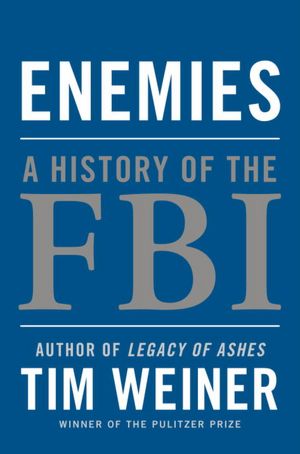
Enemies: A History Of The FBI by Tim Weiner
I'm having no luck finding a breezy book to try and match Becky's entries. OK, you win, it can't be done (No, I might be able to find a breezy book, but Becky has the patent on funny write-ups). So.... let's all read about J. Edgar Hoover and those zany guys at the FBI!
This is one heck of a story. Starts back with presidents from Lincoln on using private investigators to try and figure out what's going on inside the country and Teddy Roosevelt setting up a federal agency for the same purpose. They didn't bother with pesky things like a congressional charter (there still isn't one for the FBI) or too much oversight, because what they wanted to know normally couldn't be done with search warrants and lots of rules. This book really isn't about J. Edgar being a loose cannon. It's about every president wanting the kind of information those agencies (the FBI is only the most recent incarnation) could provide and J. Edgar doing a pretty good job of providing it.
When Nixon came on the scene, he was so far out on the paranoid edge as far as wanting info on everyone that even Hoover pulled back from him and Nixon created his own very poor spy organization (the Plumbers) with disastrous results. The fallout from Watergate hamstrung the agency, which is only now in a position to where rules exist to guide the FBI yet give them enough leeway to do the job. I got to the end of the book with hope that there can now be a balanced future between competent outcomes and infringement of personal liberties.
The is a real page-turner. There have been continuous instances of internal and external terrorists in the U.S. since the 19th century and this narrative puts them into context and actually changed some of my thinking on individual freedom vs. civic safety. The book does not focus on the federal law enforcement aspect of the agency but on intelligence gathering and how it has sometimes kept us safe and sometimes missed the boat. It's a great read and a wonderful historical perspective.
Sunday, March 04, 2012
I Shall Wear Midnight by Terry Pratchett
"So, witches had to keep one another normal or at least what was normal for witches. It didn't take very much: a tea party, a singalong, a stroll in the woods, and somehow everything balanced up, and they could look at advertisements for gingerbread cottages in the builder's brochure without putting a deposit on one." (p. 53)
Tiffany Aching is a witch and a rather young one at that. She does all the dirty business witches are expected to do (births, salves, tending to the weak) and not much of the dirty business witches are thought to do (spells and general wickedness). But when the ghost of a witch hunter is unleashed into Tiffany's world and the "rough music" dances him out of darkness and into the hearts of those who "make room for the evil," Tiffany must find the courage and skill to destroy him and reunite her village in the face of unspeakable evils and the kind of fear and ignorance that tears people apart.
"I Shall Wear Midnight" confirms that I need to be reading more Terry Pratchett. Several years ago I enjoyed a book he co-authored with Neil Gaiman called "Good Omens: The Nice and Accurate Prophecies of Agnes Nutter, Witch." I don't know why I didn't immediately pick up another of his books right then and there. Oh yeah. It's because I started reading more Gaiman. Which wasn't a bad bet. But it's nice to know he wasn't the only one running the show with "Good Omens." Pratchett is insightful and funny and neither of those words do justice to the delight it is to read his work. Dad, start with "Good Omens" and see what you think, since this one is in the YA vein. But it's good stuff. A genuine pleasure.
Friday, March 02, 2012
Steve Jobs by Walter Isaacson
Steve Jobs was an arrogant asshole. You still with me? Ok, now you should totally read this book. While I know members of this fine family have their personal feelings about Apple and Apple products, perhaps even about Steve Jobs himself, this is a book worth picking up. As an iPhone and iPad owner, I clearly drank the Kool-Aid. And boy is it tasty. Mmmm…sugar.
Focus, Becky. Ok, but seriously, you don’t need to own or have owned an Apple product or even like Apple products to have respect for just what Apple has done for our society. Good, bad, or in between, it’s changed us. And Steve Jobs, love him or hate him (and there are about 10 people, I think, who loved him), was a mad genius. And I don’t mean that in the Boston “wicked-smart” sense, either. He was mad, and he was a genius.
While this book is more than 600 pages long, I didn’t find anything slow or extraneous about it. Walter Isaacson, the author, has written a few biographies that I think mom and dad have read – Einstein and Benjamin Franklin. And as Isaacson states in his intro, he’s quite sure that Steve Jobs saw himself as a natural progression of that list.
This was a fascinating portrayal of a very complicated, mercurial, selfish, brilliant, eccentric, sensitive, strong, elusive man. He brought computers into the mainstream, made them cool, accessible, flashy, and functional. He brought animation into the 21st century before we were even in it, and he changed the way in which we buy and access music, movies, and information. Steve Jobs was an arrogant asshole. And this was one of the best books I’ve ever read.
Subscribe to:
Posts (Atom)